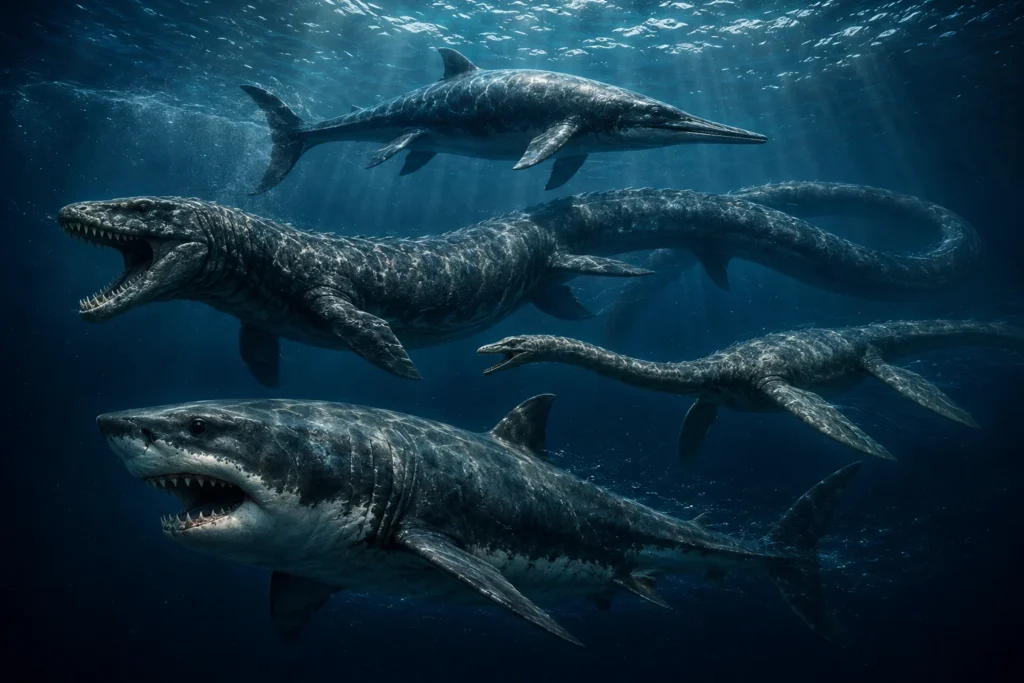
Let me tell you about these monsters: Long before dolphins, marlins, and great white sharks claimed the oceans, prehistoric seas were ruled by creatures that make today’s fastest marine animals look slow. These were the extinct fastest sea animals — apex predators shaped over millions of years of evolution into perfectly engineered killing machines.
What made prehistoric marine predators so fast? The answer lies in three core adaptations that paleontologists have confirmed through fossil analysis, computer modeling, and biomechanical study:
- Streamlined, hydrodynamic bodies that cut through dense saltwater with minimal drag.
- Powerful tails and flippers providing explosive propulsion and sustained cruising speed.
- Flexible spines and muscle architecture adapted for burst speed to ambush prey.
In this guide, we rank the 10 fastest extinct sea animals by their estimated top speeds — based on fossil evidence, bone structure analysis, and paleontological research — and explain exactly what made each one such a formidable swimmer.
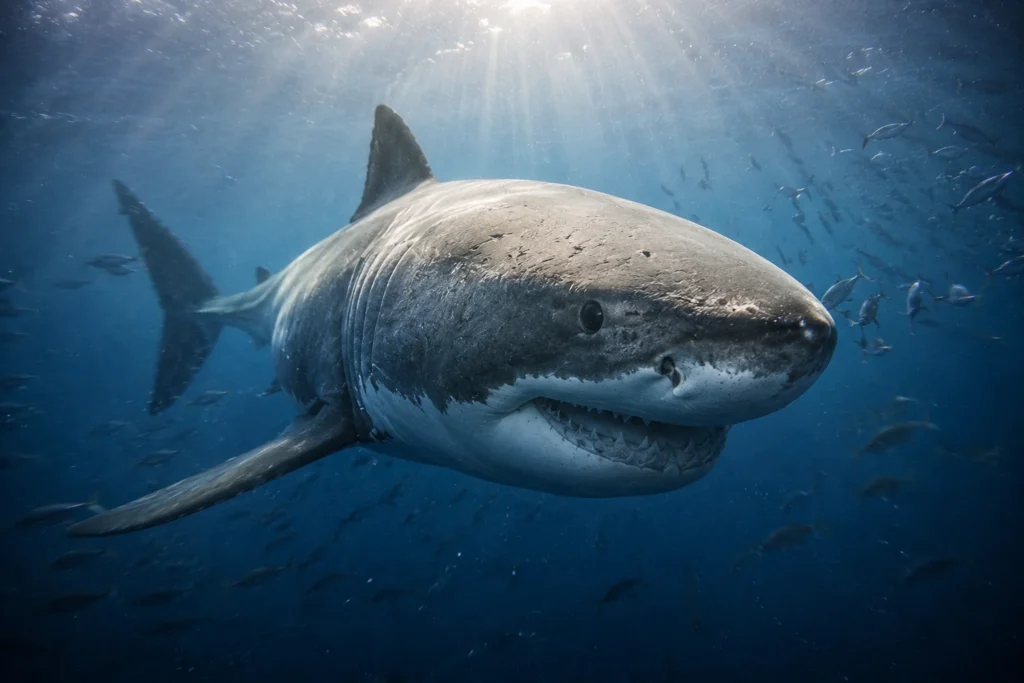
Speed estimates for prehistoric animals are derived from fossil bone structure, muscle attachment points, tail morphology, and comparison with living analogues. They represent scientific consensus estimates, not exact measurements.
Quick Reference: Top 10 Extinct Fastest Sea Animals at a Glance
Use this table for a fast overview before diving into the full profiles below.
| Rank | Animal | Period | Est. Speed | Key Adaptation |
| 1 | Ichthyosaurus | 200-190 MYA | ~50 km/h (31 mph) | Dolphin-like torpedo body |
| 2 | Tylosaurus | 85-80 MYA | ~40 km/h (25 mph) | Sleek body + powerful tail |
| 3 | Cretoxyrhina | 100-82 MYA | ~40 km/h (25 mph) | Crescent tail, shark build |
| 4 | Xiphactinus | 112-66 MYA | ~35 km/h (22 mph) | Long muscular body |
| 5 | Mosasaurus | 82-66 MYA | ~32 km/h (20 mph) | Flexible spine, huge tail |
| 6 | Thalassomedon | 95 MYA | ~32 km/h (20 mph) | Flipper-powered flight |
| 7 | Megalodon | 23-3.6 MYA | ~25 km/h (15 mph) | Raw size + muscle mass |
| 8 | Pliosaurus | 160-145 MYA | ~24 km/h (15 mph) | Powerful jaws + bulk |
| 9 | Helicoprion | 290-250 MYA | ~20-25 km/h (12-15 mph) | Fast burst ambush predator |
| 10 | Liopleurodon | 160 MYA | ~16-20 km/h (10-12 mph) | Short bursts, broad flippers |
The Full Profiles: Extinct Fastest Sea Animals Ranked
1. Ichthyosaurus — The Jurassic Speedster
- Estimated Speed: ~50 km/h (31 mph)
- Time Period: 200-190 million years ago (Early Jurassic)
- Size: Up to 6.1 m (20 ft) long
- Diet: Fish, squid, and small marine invertebrates
Ichthyosaurus is the single most important animal for understanding how fast prehistoric oceans could get. It is also one of the most remarkable examples of convergent evolution in the fossil record — a reptile that independently evolved a body almost identical to a modern dolphin, hundreds of millions of years before dolphins existed.
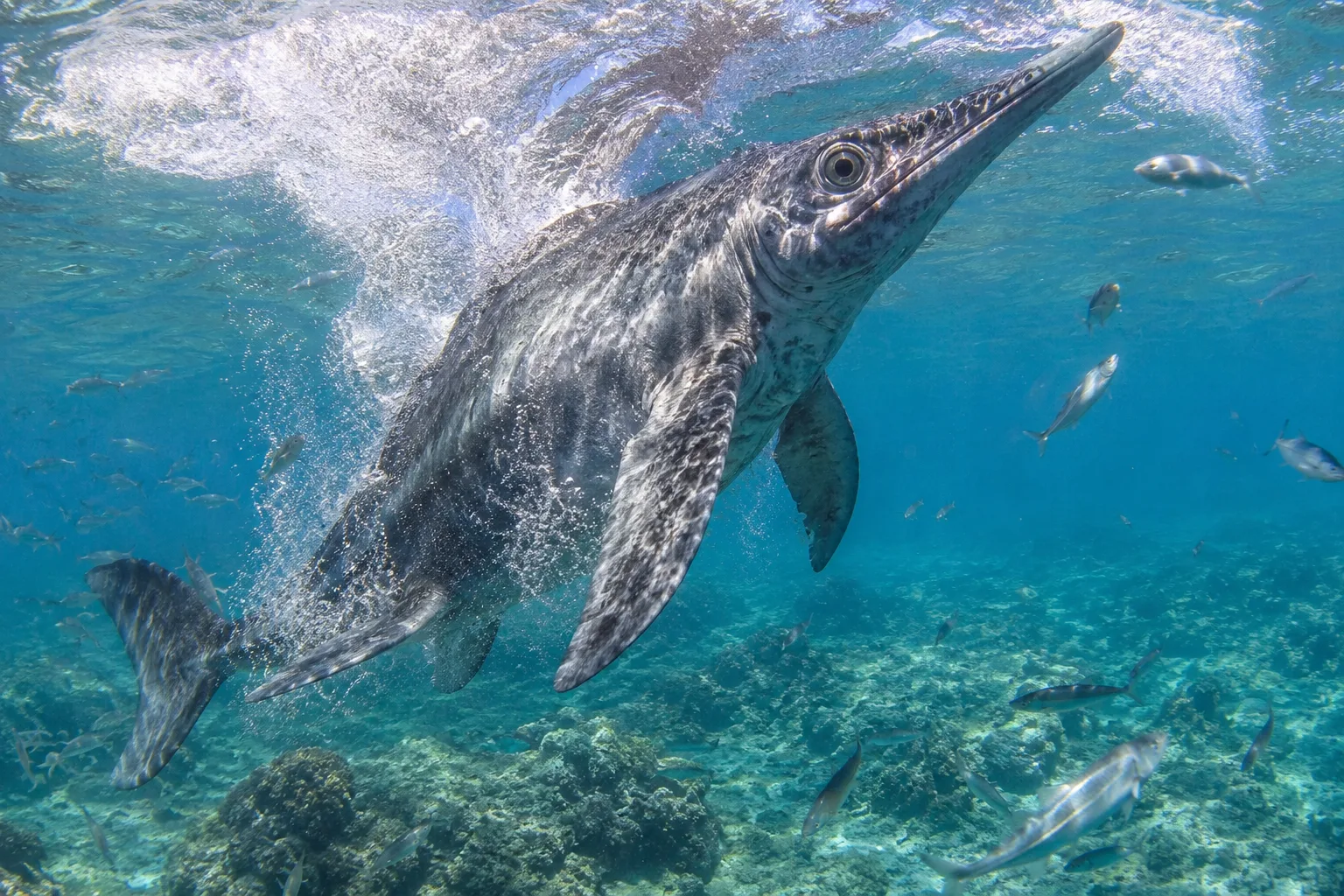
Its torpedo-shaped body, crescent-shaped tail fin, and large, streamlined skull all reduced drag to a minimum. Paleontologists estimate it swam at approximately 50 km/h (31 mph), matching or exceeding modern dolphins. Its enormous eyes — the largest relative to body size of almost any vertebrate — suggest it also hunted in low-light, deep water conditions.
Fossil discoveries have revealed that Ichthyosaurus gave birth to live young rather than laying eggs, meaning it was permanently marine and never needed to return to land — a major evolutionary leap that allowed it to fully optimize for aquatic speed.
A 2024 study published following analysis of giant ichthyosaur bones found in the UK identified a new species — Ichthyotitan severnensis — potentially over 25 meters long, suggesting the ichthyosaur family included some of the largest marine reptiles ever to exist.
What beat it? Nothing in its era came close. The fastest living sea animal today, the black marlin, reaches around 80 km/h — but it is a fish with very different physiology. Among air-breathing marine vertebrates, Ichthyosaurus was almost certainly the fastest of its time.
2. Tylosaurus — The Agile Sea Lizard
- Estimated Speed: ~40 km/h (25 mph)
- Time Period: 85-80 million years ago (Late Cretaceous)
- Size: Up to 15 m (50 ft) long
- Diet: Fish, sharks, seabirds, other mosasaurs
Tylosaurus was one of the dominant apex predators of the Late Cretaceous Western Interior Seaway — the vast shallow sea that once covered much of North America. A member of the mosasaur family, it could reach 15 meters in length, yet its body was sleek enough to hit estimated speeds of 40 km/h.
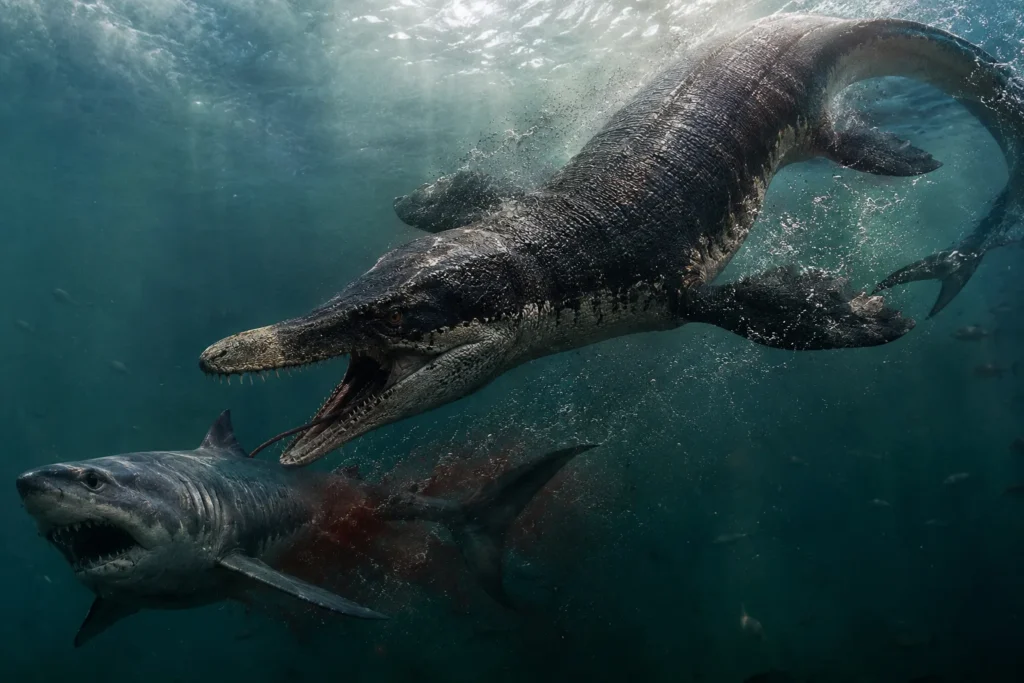
Its speed came from a long, powerful tail fin driven by lateral undulation of the spine — similar to how modern crocodilians move in water, but far more efficient. Tylosaurus did not just use speed to chase prey. Fossil evidence shows it hunted with a combination of speed and ambush, striking from below or behind with explosive bursts.
Uniquely among mosasaurs, Tylosaurus had a blunt, rounded snout rather than teeth at the very tip of its jaws, suggesting it may have used its rostrum to ram and stun prey before biting.
3. Cretoxyrhina — The Ginsu Shark
- Estimated Speed: ~40 km/h (25 mph)
- Time Period: 100-82 million years ago (Late Cretaceous)
- Size: Up to 7.6 m (25 ft) long
- Diet: Large fish, marine reptiles, pterosaurs
Cretoxyrhina — nicknamed the Ginsu Shark after the famous razor-sharp knives — was one of the largest and fastest sharks ever to swim the oceans. It pre-dates the great white shark by tens of millions of years, yet its body plan was almost identical: a streamlined fusiform shape, a powerful crescent-shaped caudal fin, and teeth designed to slice through bone.
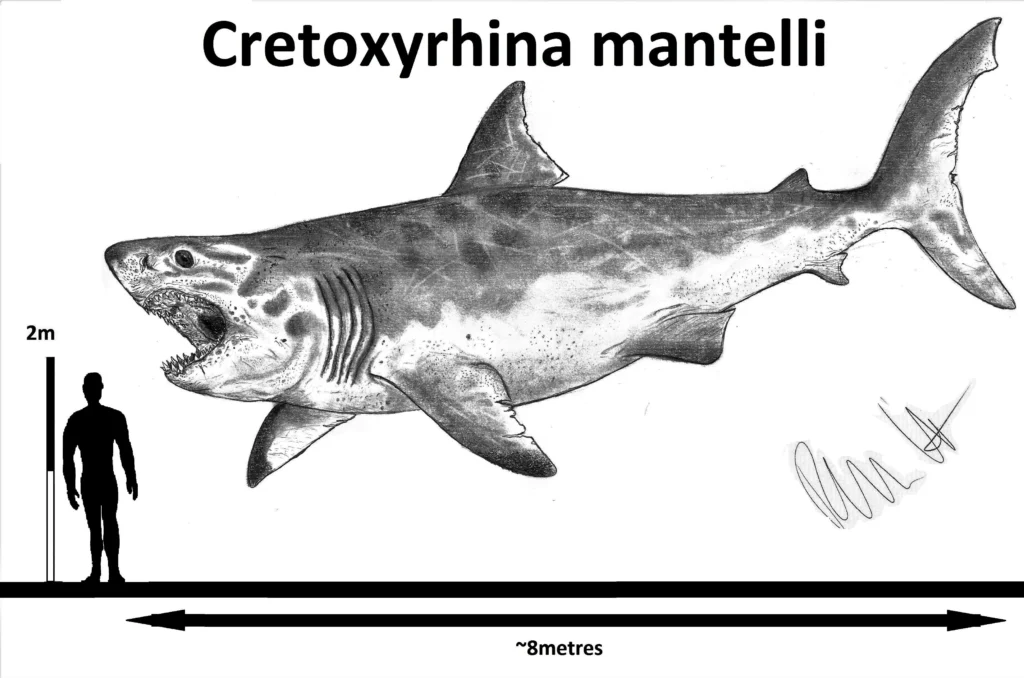
Biomechanical analysis of its tail structure suggests Cretoxyrhina was a thunniform swimmer — the same swimming style used by tuna and great white sharks today, where propulsion comes almost entirely from the powerful tail while the body stays relatively rigid. This is the most energy-efficient and fastest swimming style known in marine vertebrates.
Fossil evidence shows Cretoxyrhina preyed on Pteranodon, the giant flying reptile, suggesting it was fast enough to intercept flying animals that came too close to the water surface.
4. Xiphactinus — The Giant Fang-Fish
- Estimated Speed: ~35 km/h (22 mph)
- Time Period: 112-66 million years ago (Late Cretaceous)
- Size: Up to 6 m (20 ft) long
- Diet: Large fish, swallowed whole
Xiphactinus was the terror of Cretaceous fish. A massive predatory teleost fish that grew over 6 meters long, it combined bulk with surprising speed — a muscular, elongated body shaped like a giant tarpon, with large fang-like teeth at the front of its jaws.
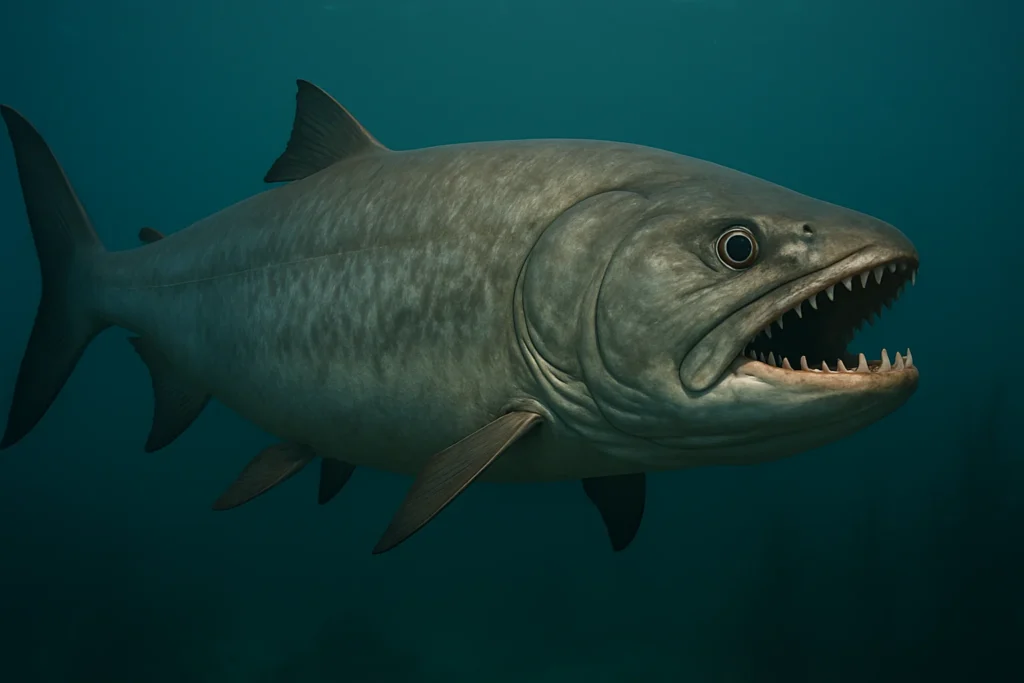
One of the most remarkable fossils ever found is a Xiphactinus specimen discovered in Kansas containing a fully intact, 1.8-meter Gillicus fish inside its stomach — apparently swallowed whole moments before death. This tells us Xiphactinus was fast enough to catch large, agile prey and powerful enough to engulf them in a single strike.
Its speed adaptation came from its elongated body profile and large, forked tail, allowing it to surge through the water in explosive bursts. It was not built for endurance cruising but for rapid, decisive attack.
5. Mosasaurus — The Marine Dragon
- Estimated Speed: ~32 km/h (20 mph)
- Time Period: 82-66 million years ago (Late Cretaceous)
- Size: Up to 18 m (60 ft) long
- Diet: Ammonites, fish, marine reptiles, anything it could catch
Mosasaurus was the largest member of the mosasaur family and one of the last great marine reptile apex predators before the mass extinction 66 million years ago wiped them all out. At up to 18 meters long — longer than a school bus — its 32 km/h speed is even more impressive when you account for sheer mass.
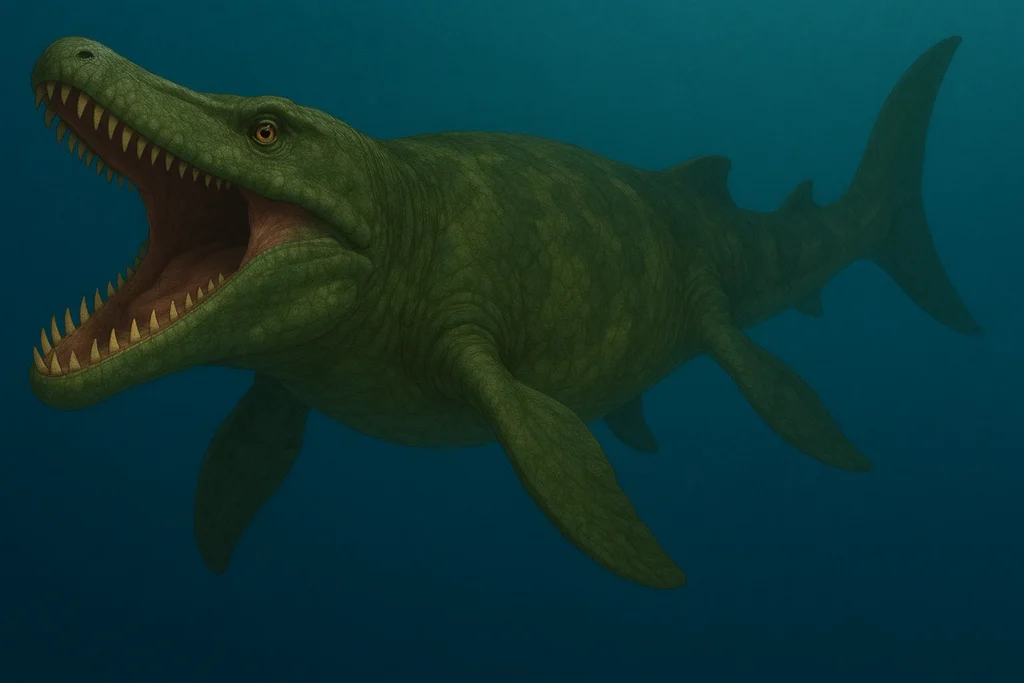
Mosasaurus had a double-hinged jaw — like a snake — that allowed it to swallow enormous prey whole. Combined with its speed, this made it one of the most effective ocean predators of any era. Its tail had a distinct downward lobe, similar to some sharks, providing efficient propulsive force.
Mosasaurus is perhaps the best-known extinct sea animal in popular culture, featured prominently in the Jurassic World films — though the movies exaggerate its size significantly.
6. Thalassomedon — The Ocean Glider
- Estimated Speed: ~32 km/h (20 mph)
- Time Period: ~95 million years ago (Late Cretaceous)
- Size: Up to 12 m (40 ft) long, neck ~6 m
- Diet: Fish and soft-bodied squid-like prey
Thalassomedon was a plesiosaur — a family of marine reptiles famous for their extremely long necks. Its name means “sea lord” in Greek, and it earned that title through an unusual swimming style: rather than undulating its body like a fish or mosasaur, it used four large, powerful flippers to essentially fly through the water, the same technique used by sea turtles and penguins today.
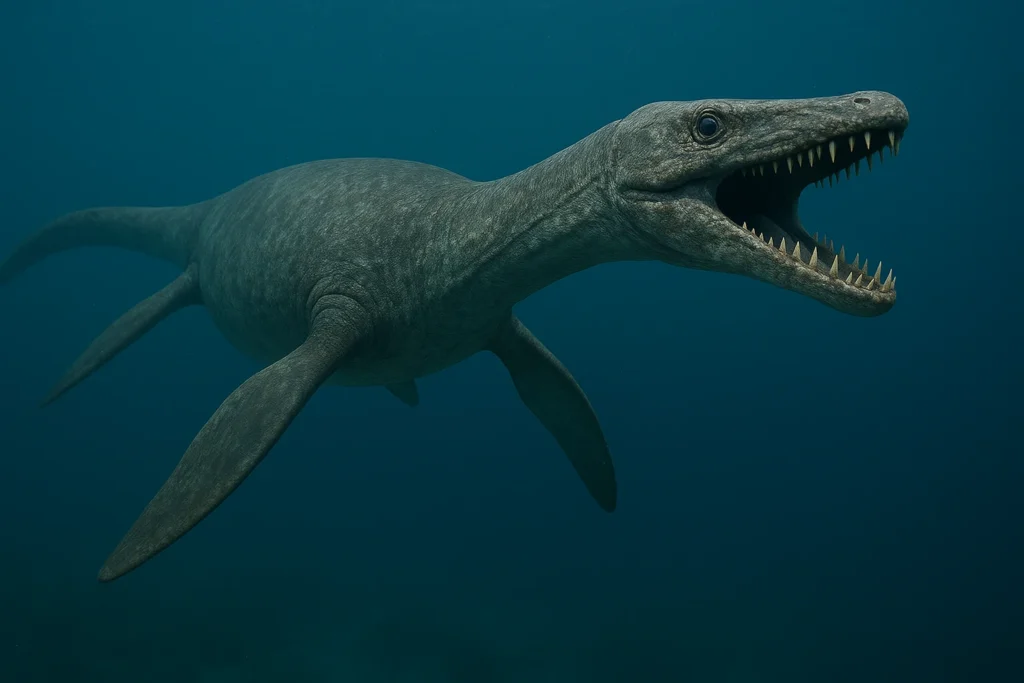
This flipper-flight style is not the fastest form of marine locomotion for burst speed, but it is highly efficient for sustained cruising. Thalassomedon was likely a patient, energy-efficient hunter that used its long neck — accounting for roughly half its total body length — to strike at fish from a distance while its body remained still, reducing the risk of alerting prey.
Paleontologists have found gastroliths (stomach stones) inside Thalassomedon fossils, suggesting it swallowed rocks as ballast to aid buoyancy control — a sophisticated behavioral adaptation.
7. Megalodon — The Titan of the Deep
- Estimated Speed: ~25 km/h (15 mph) cruising; burst estimates up to 32 km/h
- Time Period: 23-3.6 million years ago (Miocene-Pliocene)
- Size: Up to 18-20 m (60-65 ft) long
- Diet: Whales, large marine mammals, giant fish
Megalodon is the most famous extinct sea animal in the world — and for good reason. It was potentially the largest predatory fish ever to exist, with teeth over 18 cm (7 inches) long and a bite force estimated at over 180,000 newtons, the most powerful bite of any animal ever recorded.
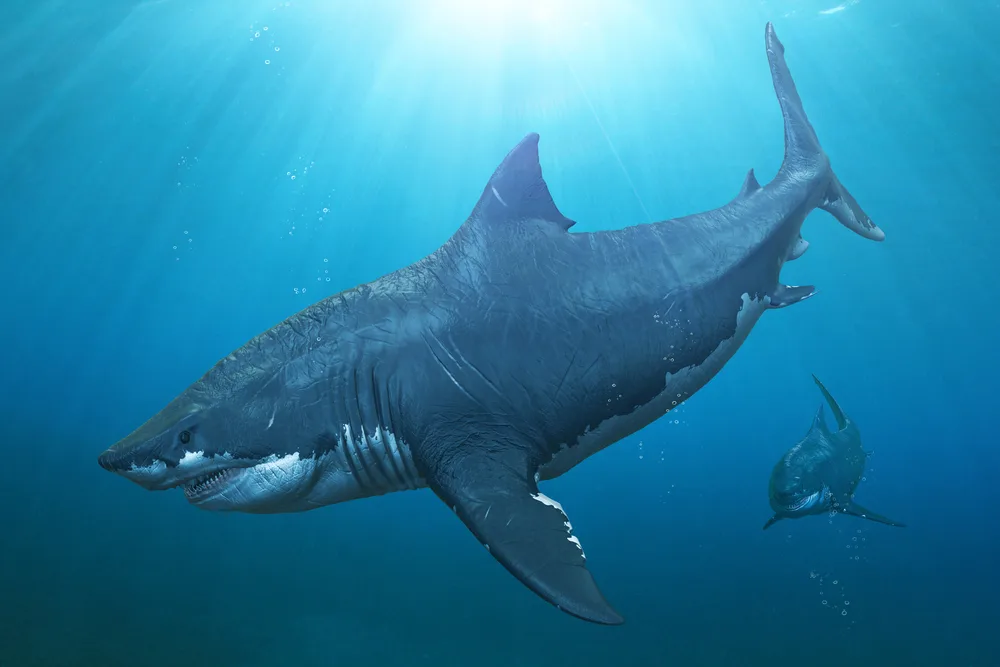
Despite its monstrous size — potentially weighing over 50 tons — Megalodon was no slow-moving giant. Hydrodynamic modeling based on its body proportions suggests sustained cruising speeds of around 25 km/h and burst speeds potentially reaching 32 km/h. For context, a great white shark reaches about 40 km/h. Megalodon was slower, but it compensated with size, bite force, and an ambush hunting strategy.
Megalodon went extinct approximately 3.6 million years ago, most likely due to oceanic cooling, the decline of its whale prey, and competition from smaller, faster predators like the ancestor of the modern great white shark.
Is Megalodon still alive? No. This is a persistent myth. The deep ocean has been extensively mapped and studied. A 20-meter apex predator would leave abundant evidence. The last confirmed Megalodon teeth in the fossil record date to approximately 3.6 million years ago.
8. Pliosaurus — The Short-Necked Super Predator
- Estimated Speed: ~24 km/h (15 mph)
- Time Period: 160-145 million years ago (Late Jurassic)
- Size: Up to 10-12 m (33-40 ft) long
- Diet: Ichthyosaurs, plesiosaurs, large fish
Pliosaurus was the apex predator of the Jurassic seas — a short-necked, massively built marine reptile with a skull up to 3 meters long and a bite force comparable to Tyrannosaurus rex. Unlike the long-necked plesiosaurs, pliosaurs evolved for speed and power over stealth, with a compact, muscular body and four enormous flippers.
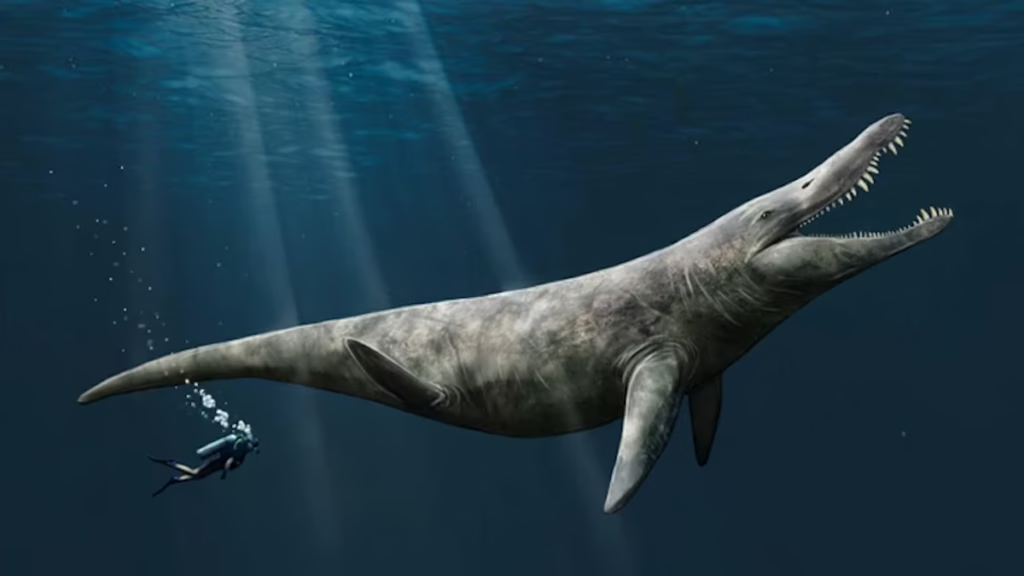
Its four-flipper swimming style, the same as Thalassomedon, was not as fast as tail-driven locomotion. But Pliosaurus compensated with raw power and an exceptionally large skull. Computer modeling of its skull has revealed that it had one of the strongest bites of any marine reptile, capable of crushing the bones of other large marine reptiles.
Pliosaurus funkei, discovered in Norway and nicknamed “Predator X,” is one of the most complete pliosaur fossils ever found and has significantly advanced our understanding of this family.
9. Helicoprion — The Buzzsaw Shark
- Estimated Speed: ~20-25 km/h (12-15 mph)
- Time Period: 290-250 million years ago (Permian)
- Size: Up to 7.5 m (25 ft) long
- Diet: Soft-bodied prey — squid-like cephalopods
Helicoprion is the most bizarre-looking animal on this list. It was an early shark relative with a unique spiral arrangement of teeth — a whorl that coiled inward like a circular saw, with older, smaller teeth on the inside and newer, larger teeth on the outside. For over a century after its discovery, paleontologists could not figure out where in its body this whorl was located.
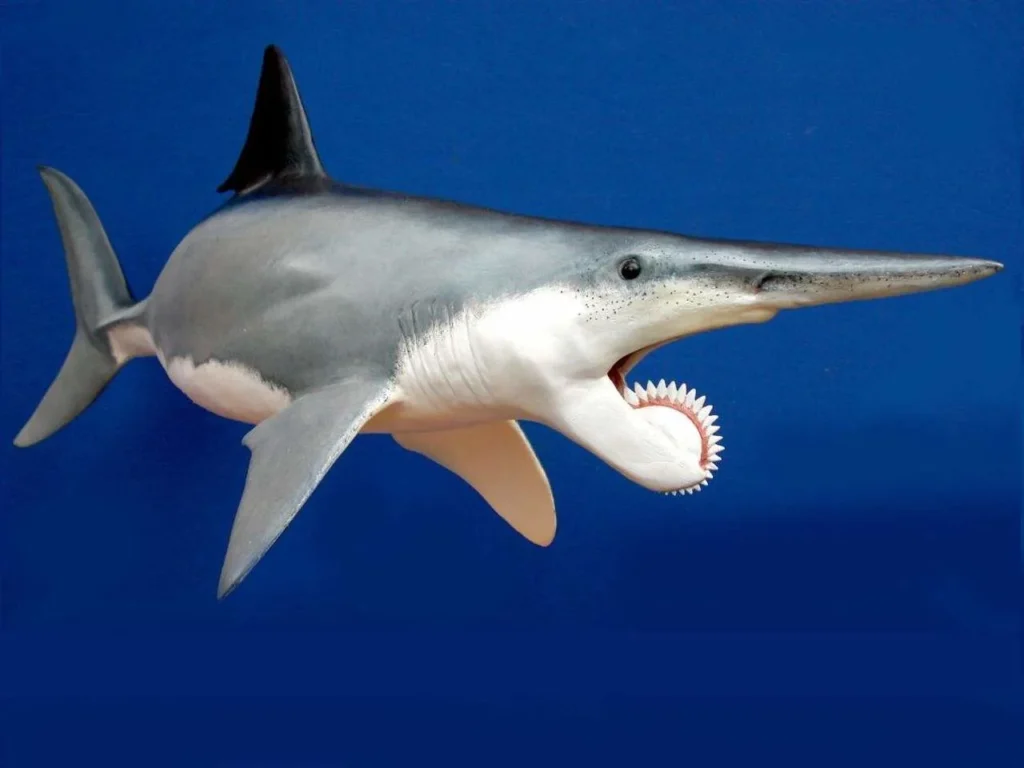
Modern CT scanning of a complete Helicoprion fossil finally solved the mystery in 2013: the tooth whorl sat entirely in the lower jaw, rotating backward as the shark closed its mouth to shred soft-bodied prey like cephalopods. This makes it one of the only animals known to have a self-sharpening, continuously regenerating cutting mechanism.
Helicoprion was not the fastest animal on this list, but its speed was sufficient for hunting fast-moving soft prey in the Permian seas. It survived the Permian-Triassic extinction event — the largest mass extinction in Earth’s history — before eventually disappearing.
10. Liopleurodon — The Power Swimmer
- Estimated Speed: ~16-20 km/h (10-12 mph)
- Time Period: ~160 million years ago (Middle-Late Jurassic)
- Size: 5-7 m (16-23 ft) long — earlier estimates of 25 m were exaggerated
- Diet: Fish, squid, and other marine reptiles
Liopleurodon has a complicated pop-culture history. A 1999 BBC Walking with Dinosaurs episode depicted it as a 25-meter monster, making it one of the most feared prehistoric predators in public imagination. The reality, based on the best fossil evidence, is more modest: most Liopleurodon specimens suggest a length of 5 to 7 meters, with some fragmentary evidence for larger individuals.
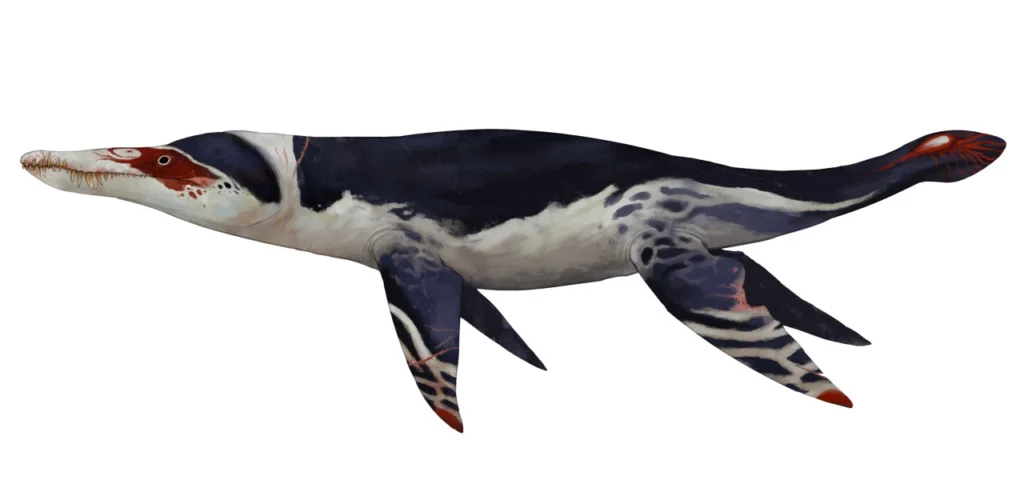
Despite being the slowest animal on this list, Liopleurodon was still an effective and feared predator. It had a large skull with four powerful flippers and strong olfactory capabilities — fossil evidence suggests it could detect the direction of chemical signals in the water by comparing concentrations between its two pairs of nostrils, a sophisticated hunting tool.
Its speed was based on short, powerful bursts rather than sustained pursuit, allowing it to ambush prey from below or behind.
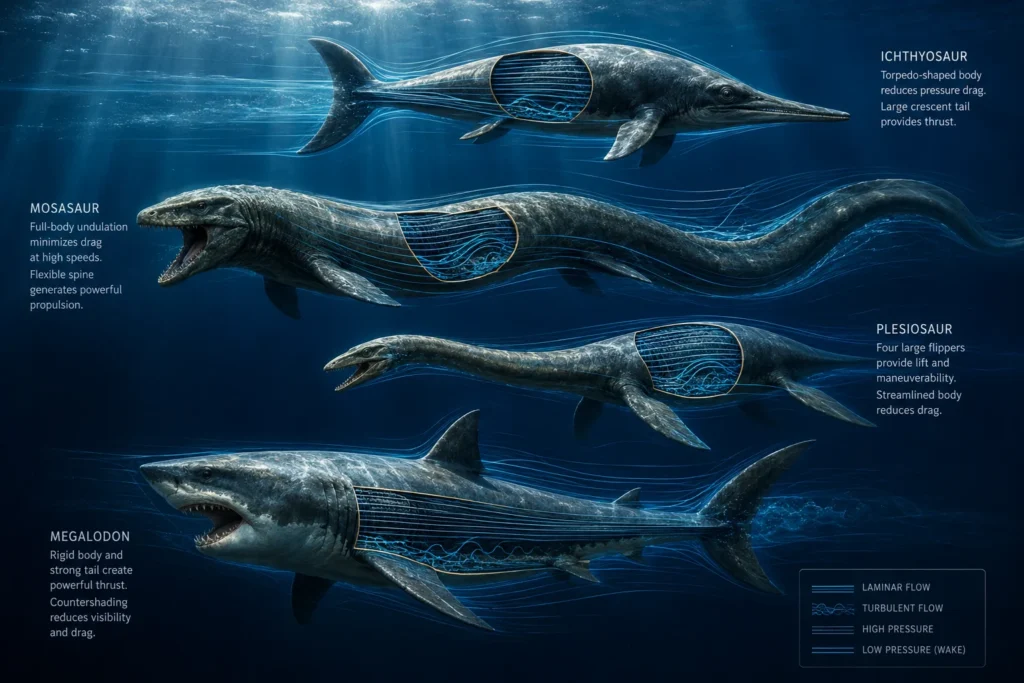
What Made These Animals So Fast? The Science of Prehistoric Speed
Speed in the ocean is not simply about muscle. Water is 800 times denser than air, which means drag is the primary enemy of any fast-moving marine animal. The extinct fastest sea animals evolved several solutions to this problem:
- Thunniform locomotion (Cretoxyrhina, Ichthyosaurus): Propulsion entirely from a stiff, crescent-shaped tail. Maximum efficiency. Used by tuna, great white sharks, and ichthyosaurs.
- Anguilliform/carangiform locomotion (Tylosaurus, Mosasaurus): Whole-body lateral undulation, like an eel or crocodile. Less efficient but powerful for large animals.
- Flipper-flight (Thalassomedon, Pliosaurus, Liopleurodon): Four-flipper propulsion like a penguin or sea turtle. Efficient cruising, less effective for burst speed.
- Body shape : Fusiform (torpedo-shaped) bodies minimize frontal area and drag. Nearly every animal on this list had some variant of this shape.
- Size and mass : Larger animals have higher top speeds in water due to favorable surface-area-to-volume ratios — which is why Megalodon, despite being slower relative to its size, still hit 25 km/h.
How Do They Compare to Modern Sea Animals?
Context matters. Here is how these extinct fastest sea animals compare to today’s fastest marine creatures:
- Black Marlin (fastest fish today): ~80-90 km/h
- Sailfish: ~110 km/h in short bursts (most cited, though debated)
- Orca (fastest marine mammal): ~56 km/h
- Bottlenose Dolphin: ~35-45 km/h
- Great White Shark: ~40 km/h
- Ichthyosaurus (fastest on this list): ~50 km/h
The fastest extinct sea animals were genuinely competitive with modern equivalents. Ichthyosaurus at 50 km/h would rival a great white shark. The key difference is that modern fish like the sailfish and marlin, being cold-blooded with highly specialized tail morphology, achieve speeds that warm-blooded marine reptiles could not match.
Frequently Asked Questions
What is the fastest extinct sea animal?
The fastest extinct sea animal is Ichthyosaurus, estimated at approximately 50 km/h (31 mph). Its dolphin-like, torpedo-shaped body and powerful crescent tail made it the most hydrodynamically efficient marine reptile of the Mesozoic era. It swam at speeds comparable to a modern great white shark.
What is the fastest extinct animal in the world overall?
On land, some pterosaurs and cursorial dinosaurs were extremely fast. In the sea, Ichthyosaurus leads the list of extinct marine animals by estimated speed. Across all extinct animals, some large pterosaurs like Pteranodon may have achieved higher air speeds in diving, but for sustained swimming, Ichthyosaurus takes the title.
What is the biggest extinct sea animal?
The biggest extinct sea animal was likely an ichthyosaur. A 2024 scientific study identified Ichthyotitan severnensis from fossil bones found in the UK, estimating a length potentially exceeding 25 meters — larger than a blue whale. Earlier candidates include Shastasaurus at ~21 meters and Shonisaurus sikanniensis at ~21 meters. Megalodon, while enormous at 18-20 meters, was likely not the largest overall.
What are the names of extinct sea animals?
Some of the most well-known extinct sea animals include: Ichthyosaurus, Mosasaurus, Tylosaurus, Megalodon, Liopleurodon, Pliosaurus, Thalassomedon, Cretoxyrhina, Xiphactinus, Helicoprion, Dunkleosteus, Elasmosaurus, Kronosaurus, and Basilosaurus. Each ruled different periods of ocean history across hundreds of millions of years.
Are any of these extinct sea animals still alive?
No. All ten animals on this list are definitively extinct, confirmed by the fossil record. Megalodon — the most commonly rumored — went extinct approximately 3.6 million years ago. The deep ocean has been extensively mapped using sonar, submersibles, and environmental DNA sampling. No evidence of a surviving Megalodon or any other animal from this list exists.
What animal went extinct the fastest?
In terms of speed of extinction rather than swimming speed, the Pyrenean Ibex holds the record for the fastest documented modern extinction — the last individual died in 2000. Among prehistoric marine animals, the mosasaurs went extinct with extraordinary rapidity during the end-Cretaceous mass extinction approximately 66 million years ago, disappearing from the fossil record within a geologically brief window.
What is the fastest sea creature alive today?
The sailfish is often cited as the fastest sea creature, with reported speeds of up to 110 km/h, though some scientists dispute measurements above 80 km/h. The black marlin is another contender, with well-documented speeds over 80 km/h. Among marine mammals, the orca (killer whale) is the fastest at approximately 56 km/h.
Did any of these extinct animals and humans exist at the same time?
None of the ten animals on this list coexisted with modern humans. The most recent, Megalodon, went extinct approximately 3.6 million years ago — roughly 1.6 million years before our species, Homo sapiens, appeared. The earliest humans evolved around 300,000 years ago.
What caused these prehistoric sea creatures to go extinct?
Different animals went extinct for different reasons. Mosasaurs, plesiosaurs, and many other large marine reptiles were wiped out 66 million years ago by the asteroid impact that also ended the non-avian dinosaurs. Megalodon likely succumbed to oceanic cooling, prey reduction, and competition from more agile predators. Helicoprion survived the Permian mass extinction but disappeared in the Triassic. Each extinction had its own cause rooted in ecological and geological change.
Final Thoughts
The oceans of the past were not gentle places. For hundreds of millions of years, the seas were ruled by creatures whose speed, size, and predatory sophistication rival anything alive today. The extinct fastest sea animals on this list — from the dolphin-like Ichthyosaurus to the monstrous Megalodon — each represent extraordinary evolutionary solutions to the challenge of moving fast through water.
Understanding these animals does more than satisfy curiosity. It reveals how evolution solves the same problems repeatedly through convergent evolution, how mass extinctions reshape entire ecosystems, and how the oceans we know today — ruled by dolphins, sharks, and whales — are just the latest chapter in a story 500 million years long.
Speed was as vital in prehistoric oceans as it is today — whether to hunt, flee, or dominate. These animals are gone, but their legacy survives in every streamlined body, every crescent tail, and every explosive burst of speed you see in today’s ocean predators.
Interested in more prehistoric and unusual sea life? See our guide to the scariest extinct sea creatures and our list of the top 10 most loyal animals in the world.





Thanks for finally talking about > Top 10 Extinct Fastest Sea Animals That Once Ruled the Seas – Animal Sound < Liked it!