The Fundamental Question of Ownership
Can You Own a Quokka as a Pet?
Let’s get straight to the point: No, you absolutely cannot own a quokka as a pet. This isn’t a gray area or a matter of finding the right permit; it is a strict and total prohibition backed by Australian law. Quokkas are a protected species, and it is illegal to keep them as pets, harm them, or remove them from their native habitat in Australia.
The only people legally qualified to care for these animals in captivity are highly trained wildlife professionals working in zoos, wildlife parks, and conservation sanctuaries. These facilities are not keeping them as pets but are dedicated to species preservation, research, and public education. This rule isn’t just bureaucratic red tape; it is a critical measure put in place to protect a vulnerable species teetering on the edge. The rest of this guide will explain the many reasons behind this absolute ban.
Legal Considerations for a Quokka Pet
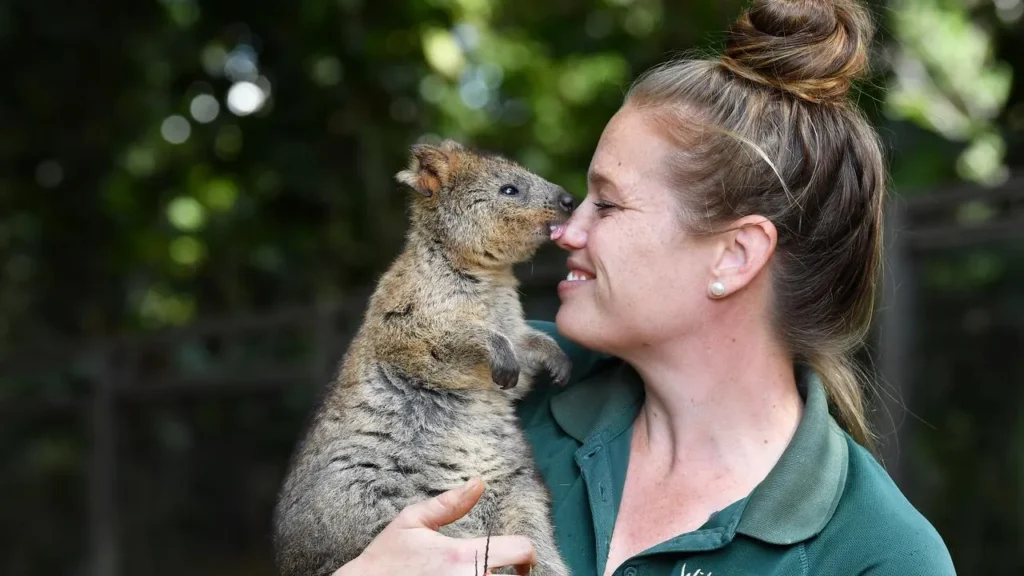
The legal protections surrounding quokkas are not just a single law but a multi-layered shield designed to defend them from various threats. Each regulation is a direct, targeted response to a specific ecological or human-induced danger, making the idea of a Quokka as a Pet a legal impossibility.
The legal framework is robust and unforgiving. A key piece of legislation is the Rottnest Island Authority Act of 1987, which specifically outlaws the transport of quokkas from the island—their most significant and stable population stronghold. This hyper-local law was created to protect the densest population from its biggest threat: human interference.
Beyond that specific island, broader Australian wildlife laws form another protective barrier. The Commonwealth Environment Protection and Biodiversity Conservation Act 1999 and Western Australia’s Wildlife Conservation Act 1950 both list the quokka as a protected species. Under these acts, licenses to keep native mammals are extremely restricted and are generally only granted to zoos and wildlife parks for legitimate educational or conservation purposes.
This legal protection is essential because quokkas are officially classified as a “Vulnerable” species on the IUCN Red List. This designation means they face a high risk of extinction in the wild. While the population on Rottnest Island is relatively stable, their numbers on mainland Australia have plummeted due to habitat loss and introduced predators.
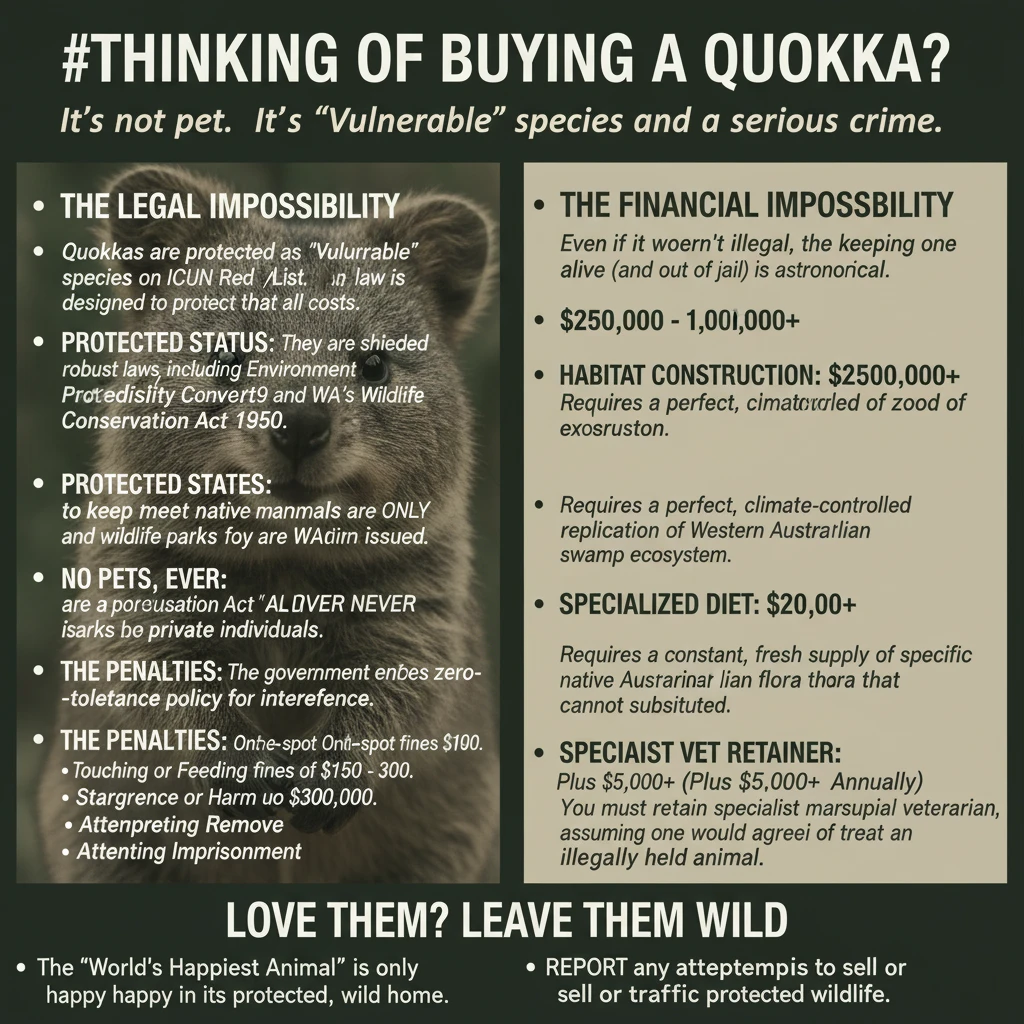
To enforce these protections, the Australian government has instituted severe penalties for anyone who interferes with the animals. The fines are tiered to address everything from well-intentioned ignorance to outright cruelty:
- Touching or Feeding: Simply touching or feeding a quokka can result in on-the-spot fines ranging from $150 to $300.
- Interference and Harm: More serious offenses, such as attempting to remove a quokka or acts of animal cruelty, can lead to staggering fines of up to $10,000, $50,000, or even $300,000, along with potential imprisonment.
These laws and penalties send a clear message: quokkas are treasured natural wildlife, not commodities, and their protection is a matter of national importance.
The Practical and Financial Realities of a Quokka as a Pet
Quokka Pet Price
Because it is completely illegal to buy, sell, or own a quokka, there is no legitimate price tag for one. Any person or website claiming to sell a quokka is an illegal wildlife trafficker, and participating in such a transaction would make the buyer complicit in a serious crime that harms a vulnerable species.
However, there is one ethical and legal way to “buy” a quokka: through a symbolic adoption. Conservation organizations like the World Wildlife Fund (WWF) and the Rottnest Foundation offer “Adopt-A-Quokka” programs. This isn’t ownership in the traditional sense. Instead, for a donation—typically ranging from $60 to $105—you receive a kit that may include a plush quokka toy, an official adoption certificate, and information about the species.
This clever approach redirects the public’s desire to own a quokka into a force for good. The money from these symbolic adoptions goes directly toward funding vital conservation projects, such as habitat restoration and research, that help protect the quokka population in the wild. In this way, the concept of “price” has been successfully reframed by the conservation community. The only way to financially “acquire” a quokka is to invest in its survival, shifting the public mindset from “How much to own one?” to “How can I help them?”
The Cost of Taking Care of a Quokka
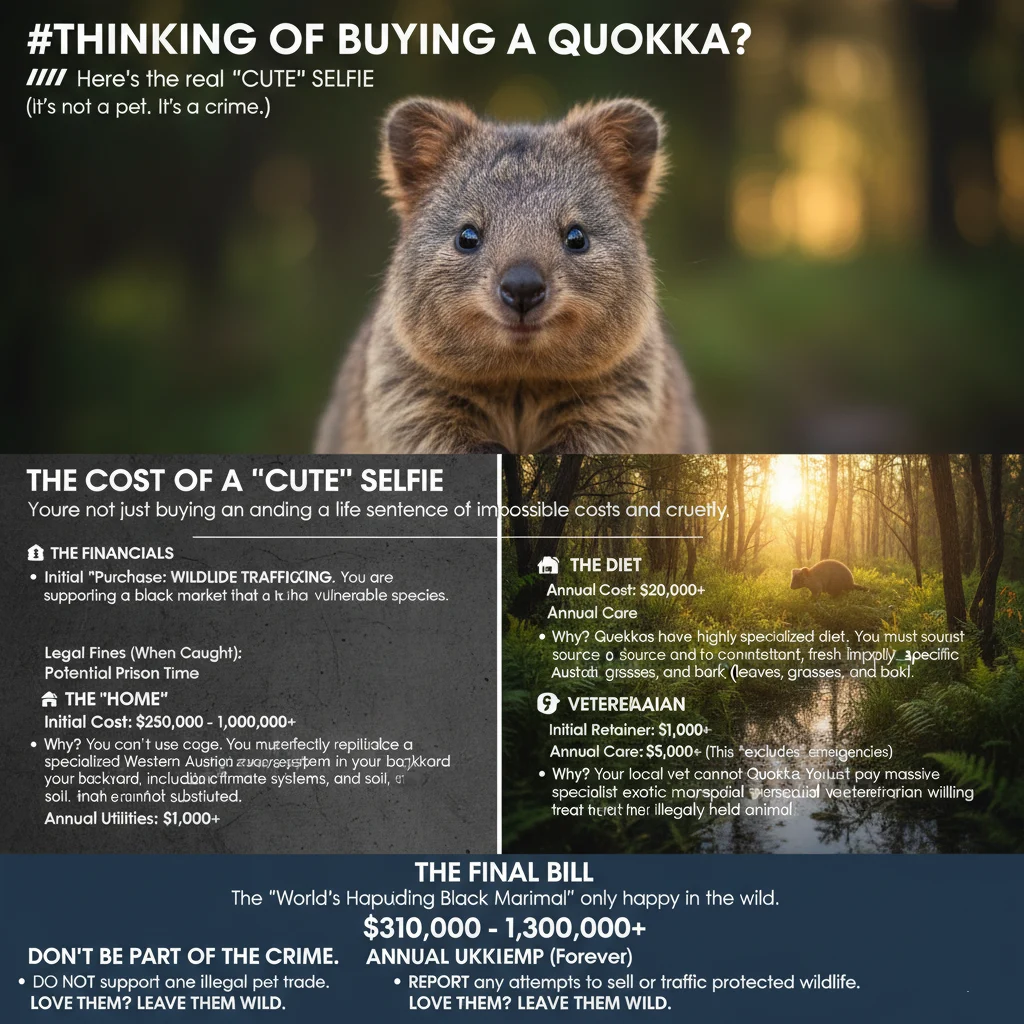
Since actual ownership is illegal, let’s engage in a thought experiment to understand the astronomical and prohibitive costs that would be involved if it were not. This exercise clearly demonstrates why private ownership is not just illegal but also completely impractical. The financial burden would be immense, far exceeding that of any conventional pet.
The single greatest expense would be habitat replication. A quokka cannot live in a backyard; it requires a large, climate-controlled enclosure meticulously designed to replicate the specific swampy, densely vegetated ecosystem of southwestern Australia. This would involve specialized soil, running water features, and the cultivation of specific native Australian plants that are essential for their diet and shelter.
Next is the specialized diet. Sourcing a constant supply of fresh, young growth from specific native Australian plants—their preferred food—would be a logistical and financial nightmare. Standard herbivore pellets available at a pet store would be woefully inadequate and could cause severe health problems.
Furthermore, veterinary care would require retaining a specialist exotic animal veterinarian with expertise in marsupial medicine, who would need to be available for consultation 24/7. Finally, one must consider the inevitable legal fees and fines upon being discovered, which could easily run into the hundreds of thousands of dollars.
| Expense Category | Estimated Initial Cost | Estimated Annual Cost | Notes |
| Illegal Acquisition | Black Market Price (Varies) | – | Supports the criminal wildlife trade. |
| Habitat Construction | $250,000 – $1,000,000+ | $15,000+ (Utilities) | Requires replicating a specific WA swamp ecosystem. |
| Specialized Diet | – | $20,000+ | Sourcing specific, fresh native Australian flora. |
| Specialist Vet Retainer | $10,000+ | $5,000+ (Excluding Emergencies) | Requires a vet with marsupial expertise. |
| Legal Fines (If Caught) | $50,000 – $300,000+ | – | Plus potential imprisonment. |
| TOTAL | $310,000 – $1,300,000+ | $40,000+ | Excluding the initial illegal purchase. |
Quokka Pet Veterinary Care
The veterinary needs of a quokka extend far beyond what a standard clinic for cats and dogs can provide. They require an exotic animal veterinarian, a specialist who has undergone extensive training beyond veterinary school to treat non-traditional pets. Even within this specialty, finding a vet with specific, hands-on experience with marsupials would be a rare and expensive challenge.
Quokkas have unique health needs and vulnerabilities. They are known to carry diseases like salmonella, which can be transmitted to humans. They also have a peculiar susceptibility to muscular dystrophy, so much so that they have been used in medical research to study the disease in humans. A domestic environment would expose them to a host of new germs and pathogens against which they have no natural immunity.
Moreover, the immense stress of captivity for a wild, non-domesticated animal would almost certainly trigger a cascade of health problems. The stress of being transported and held in an improper environment can make them irritable, aggressive, and can even be fatal. Because there is no established body of knowledge for treating quokkas in a home setting, any veterinarian would be operating with limited information, making effective and ethical care nearly impossible.
Understanding the Wild Nature of the Quokka
Care for a Quokka as a Pet: A Complex Challenge
Properly caring for a quokka is a full-time, scientific endeavor, not a hobby. It involves perfectly balancing three critical elements that are nearly impossible for a private owner to provide: a highly specific habitat, a specialized diet, and a complex social environment.
Adding to the complexity is their natural schedule. Quokkas are primarily nocturnal animals. They spend the hot Australian days sleeping in dense vegetation and become active at night to forage for food. This means they would be awake and active when their human caretaker is asleep, and sleeping during the day when interaction would be desired. Forcing a nocturnal animal into a human’s diurnal (daytime) schedule would be incredibly stressful and cruel, leading to severe health consequences.
Quokka as a Pet Habitat Requirements
Quokkas are not adaptable generalists; they are “habitat specialists,” meaning their survival is intricately linked to a very specific type of environment. A typical home or backyard could never meet their complex needs. To remove a quokka from its native habitat is to sever its life-support system.
Key elements of their required habitat include:
- Dense Vegetation: They need thick, dense ground cover and shrubbery for shelter. This is not just for comfort; it’s essential for hiding from predators and escaping the heat of the day. They create intricate paths and runways through this vegetation that they use for quick escapes.
- Swamps and Water Sources: Quokkas have surprisingly high water requirements and are almost always found in or near swampy, streamside habitats where moisture is abundant.
- A Specific Climate: They are adapted to the unique climate of southwestern Australia. This region is currently experiencing drying trends due to climate change, which is further shrinking their already limited available habitat.
- Post-Fire Ecology: Their diet and survival are closely tied to the cycles of nature. They thrive on the fresh, nutrient-rich plant growth that emerges in the years following a bushfire.
A quokka is effectively an ecological hostage; its well-being is held captive by the intricate requirements of its native ecosystem. Replicating this is not like building a nice enclosure; it’s like trying to build a small, functioning biome in your backyard. This reframes the challenge of keeping a Quokka as a Pet from being merely “difficult” to being ecologically and biologically impossible for any private individual.
Quokka as a Pet Diet
The dietary needs of a quokka are as specialized as their habitat requirements. They are browsing herbivores, meaning they selectively eat parts of various plants rather than just grazing on grass. Their diet consists of a variety of native Australian grasses, leaves, stems, and bark.
They show a distinct preference for new, young plant growth, which is softer and more nutritious. Studies have identified specific plants, such as those from the Thomasia species and various succulents, as their favorites. This highly specialized diet is impossible to replicate outside of their native environment.
It is critically important to understand that human food is dangerous for them. Even seemingly harmless foods can cause severe dehydration, illness, and long-term health problems. This is a primary reason why feeding the quokkas on Rottnest Island is strictly illegal and heavily fined.
Their bodies have also developed fascinating adaptations to their environment. They can store fat in their short tails to use as an energy reserve when food is scarce. They can also survive for up to a month without drinking by extracting sufficient moisture from the succulent plants they eat. These are not traits of an adaptable animal, but of one that is perfectly and precisely tuned to its unique home.
Quokka Social Needs
The smiling face of the quokka might suggest a simple, friendly personality, but their social lives are complex and not suited for a human-centric home. They are not cuddly companions looking for a pack leader.
Their social structure is largely determined by gender. Males form dominance hierarchies, often based on size and weight. The most dominant males compete for access to the best shady shelter sites and the most receptive females. In contrast, females tend to be much more solitary, often avoiding interactions with other females.
While they can be found in large, loose groups of up to 150 individuals on Rottnest Island, this is primarily because resources like food and water are concentrated in certain areas. These are not tightly-knit social packs but rather loose associations. On the mainland, where they face more threats, they tend to live in smaller, more discreet family groups. Removing a quokka from this environment would deprive it of the ability to engage in these natural, complex behaviors, causing significant psychological stress and loneliness.
What is the Lifespan of a Quokka?
In the wild, a quokka has an average lifespan of about 10 years, though some may live up to 15 years. In a protected captive environment, such as a professionally managed zoo or conservation park, their maximum recorded lifespan is slightly longer, at 13.8 years. This increase is due to the complete absence of predators, a consistent and appropriate food supply, and access to expert veterinary care.
It is crucial to understand that “captivity” in this context refers only to these professional, science-based facilities. A quokka kept illegally in an improper domestic setting would not experience this longevity. In fact, due to the immense stress, improper diet, and high risk of disease, its lifespan would likely be drastically and tragically shortened.

Behavior, Myths, and Human Interaction
Are Quokkas Friendly to Humans?
This is perhaps the biggest misconception about quokkas. Their seemingly “friendly” behavior is more accurately described as a profound lack of fear. This trait is a direct result of their unique environment, particularly on Rottnest Island, where they have evolved for generations with few to no natural predators. Without the instinct to flee from larger creatures, they exhibit a natural curiosity toward humans.
They will often approach people, which is what makes the famous #quokkaselfie possible. However, this curiosity should never be mistaken for the kind of affection, loyalty, or bonding that is seen in domesticated animals like dogs. They are not seeking friendship; they are investigating a strange, non-threatening element in their environment. This is an environmental anomaly, not an inherent sign that they are meant to be pets.
Can Quokkas Get Aggressive?
Yes, absolutely. Despite their charming smiles, quokkas are wild animals equipped with sharp teeth and claws, and they will use them to defend themselves if they feel threatened or cornered. Dozens of people are bitten by quokkas on Rottnest Island each year, usually as a result of getting too close or attempting to touch or feed them.
While they generally prefer to flee from conflict, they can exhibit aggressive posturing, such as “boxing” with their forearms, if competing for resources or territory. They are not inherently aggressive, but their docile appearance belies the fact that they are capable of inflicting a painful bite when provoked.
Are Quokkas Tame?
To answer this, one must understand the difference between “tame” and “domesticated.” A tame animal is an individual wild animal that has lost its fear of humans through habituation. A domesticated species, on the other hand, is one that has been selectively bred over many generations to live alongside humans, like dogs or cats.
Quokkas are not domesticated. They are wild animals that have not undergone the thousands of years of genetic modification that separates a pet from a wild creature. They cannot be housebroken, trained, or relied upon to coexist peacefully in a human home. While some individual quokkas on Rottnest Island could be described as tame due to constant human exposure, the species as a whole remains fundamentally wild.
Why Do Quokkas Sacrifice Their Babies? The Truth Behind the Myth
A popular internet meme suggests that mother quokkas are terrible parents who carelessly “throw” their babies at predators to save themselves. This idea began as a joke but has since been widely and incorrectly reported as fact. The truth is far more complex and fascinating.
Quokkas do not physically throw their young. What actually happens is a desperate, last-ditch survival tactic. When a mother quokka with a joey in her pouch is being chased by a predator, she can consciously relax her pouch muscles. This causes the baby to fall out onto the ground. The joey, now exposed, will often make loud hissing and squealing noises, which creates a momentary distraction for the predator.
This gives the mother—a proven, fertile adult who is vital for the continuation of the species—a chance to escape. It is a brutal but effective evolutionary strategy, similar to how a lizard will drop its wriggling tail to distract a predator and flee. This behavior is a response to extreme fear and is a powerful reason why people should never harass or chase these animals.
Why Are Quokkas Bad Parents? A Misguided Question
Applying human moral judgments like “good” or “bad” parenting to the survival strategies of wild animals is a fundamental misunderstanding of the natural world. A quokka mother’s actions are not driven by a lack of love but by the cold, hard logic of evolutionary mathematics.
From a species survival standpoint, the strategy is brilliant:
- Scenario 1: The predator catches the mother. In this case, both the mother and the joey in her pouch die. The genetic line ends.
- Scenario 2: The mother sacrifices the joey and escapes. In this case, she lives to reproduce again. A female quokka can produce around 17 babies over her lifetime and may even have “backup” embryos in a state of suspended development in her womb, ready to grow if her current joey is lost.
The strategy prioritizes the proven reproductive asset (the mother) over a single, vulnerable offspring to ensure the long-term survival of the species. It is not poor parenting; it is a brutal but effective tactic for survival in a harsh world.
What If a Quokka Touches You?
Given their curious nature on Rottnest Island, it’s possible a quokka may approach you and even touch you. The correct and legal response is simple: do not touch it back. Stay still and allow it to move away, or calmly move away yourself. It is illegal for you to initiate contact, and you can be fined on the spot even if the quokka was the one to approach you.
There are several critical reasons for this strict “no-touch” policy:
- Disease Transmission: Human germs can make quokkas sick. Furthermore, an unfamiliar human scent on a joey can cause its mother to abandon it. Quokkas can also carry bacteria like salmonella, which can be harmful to you.
- Safety: Getting too close invites a potential bite if the animal suddenly feels threatened.
- Fines: Park rangers actively look for people attempting to pet or pick up the animals and will issue fines.
If you do accidentally come into physical contact with a quokka, it is recommended that you wash the area with soap and water as soon as possible to minimize any risk of infection.
The Final Verdict and Responsible Alternatives
Ethical Considerations of Quokka Ownership
Beyond the legal and practical barriers, there are profound ethical reasons why quokkas should never be pets. The core of the issue is animal welfare. To take a wild, non-domesticated animal and confine it to an artificial environment that cannot possibly meet its complex ecological, dietary, and social needs is inherently cruel.
From a conservation perspective, creating any demand for quokkas as pets would be catastrophic. It would inevitably fuel an illegal black market of poaching and wildlife trafficking, directly contributing to the decline of an already vulnerable species. Every animal stolen from the wild is a devastating loss to the population’s genetic diversity and its ability to survive. Even the #quokkaselfie trend, while often harmless, raises ethical questions. It encourages close human-wildlife interaction, which can cause stress to the animals and habituate them to humans, making them more vulnerable in the long run.
Conclusion: Should You Keep a Quokka as a Pet?
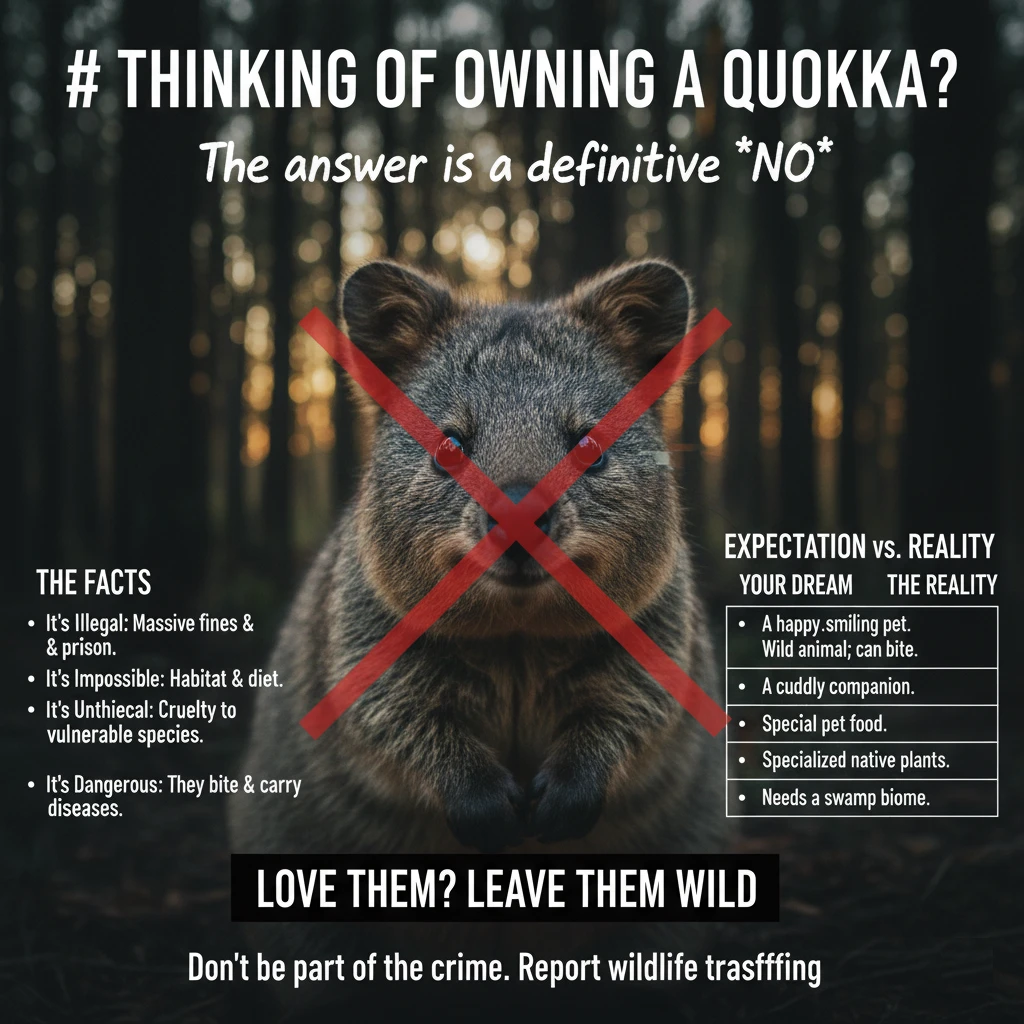
After examining the evidence from every angle, the answer is a final, definitive, and resounding No. The dream of owning the world’s happiest animal is just that—a dream. The reality is that attempting to keep a Quokka as a Pet is illegal, impossibly difficult, unethical, and dangerous.
To summarize the key reasons:
- It’s Illegal: A robust framework of laws and massive fines are in place to protect them.
- It’s Impossible: You cannot replicate their highly specialized habitat or diet.
- It’s Unethical: It is cruel to the individual animal and harmful to the species as a whole.
- It’s Dangerous: They are wild animals that can bite and carry diseases.
The gap between the fantasy of a smiling pet and the harsh reality is immense.
| Your Expectation | The Reality |
| A happy, smiling companion. | The “smile” is facial anatomy; they are wild animals, not perpetually happy. |
| A cuddly, affectionate pet. | They are not domesticated, can be aggressive, and bite dozens of people a year. |
| A fun daytime playmate. | They are nocturnal and spend the day sleeping. |
| I can buy one if I have the money. | It is illegal to own, buy, or sell them, with massive fines for doing so. |
| I can feed it special pet food. | They require a highly specialized diet of specific native Australian plants to survive. |
| It can live in my house/yard. | They need a specific, swamp-like habitat with dense vegetation to feel safe and thrive. |
Alternatives to Owning a Quokka
The fascination with quokkas is understandable, and that passion can be channeled into positive actions that help rather than harm them. If you truly love these animals, the best thing you can do is support them in the wild.
Here are some wonderful and ethical alternatives to ownership:
- Symbolically Adopt a Quokka: This is the best way to feel a sense of connection. Your donation directly funds their conservation and protects their habitat.
- Visit Responsibly: You can travel to Rottnest Island in Western Australia to see them in their natural environment. If you go, be a responsible tourist: always stay on designated paths, never touch or feed the animals, and observe them from a respectful distance.
- Donate to Conservation: Contribute to organizations like the Rottnest Foundation or WWF Australia, which are on the front lines of protecting quokka habitats and funding research.
- Educate and Advocate: The greatest gift you can give the quokka is to be a voice for its preservation. Watch documentaries, learn about the threats they face, and share accurate information with others to combat harmful myths and the dangerous desire for illegal wildlife pets.
By turning admiration into action, you can become a true champion for the world’s happiest animal, ensuring that their smiles continue to grace their wild island home for generations to come.
The quokka is a peculiar yet adorable little creature that has won the hearts of millions worldwide, thanks to its seemingly permanent smile and docile temperament. Often referred to as “the world’s happiest animal,” the quokka has become a viral sensation. However, many people wonder: can you own a quokka as a pet? Is it legal? How much does it cost to take care of one? This guide will answer these questions in detail while exploring the realities of quokka ownership.
Can You Own a Quokka as a Pet?
Quokkas are often considered one of the happiest-looking animals, but their high-energy lifestyle and need for natural vegetation make them unsuitable as traditional pets. This is similar to the deer, which also requires a large, secure outdoor habitat to thrive.
Is It Legal to Own a Quokka?
If you’re considering a quokka pet for sale, you may be disappointed to learn that quokkas are protected under Australian law. The Rottnest Island Authority Act of 1987 prohibits the transportation of quokkas out of their native habitat, and exporting these animals is strictly illegal.
Can You Have a Quokka as a Pet in Australia?
In Australia, quokkas are classified as protected wildlife, meaning they cannot be legally kept as pets. Anyone found attempting to capture, own, or trade a quokka faces severe fines and legal consequences.
Can You Have a Quokka as a Pet in the United States?
Unfortunately, keeping a quokka as a pet in the United States is also illegal. Since they are protected under Australian law, exporting them from the country is forbidden.
Can We Buy Quokka?
There are no legitimate sources where you can buy a quokka. Any website or individual claiming to sell a quokka as a pet is either misleading or engaging in illegal activity.
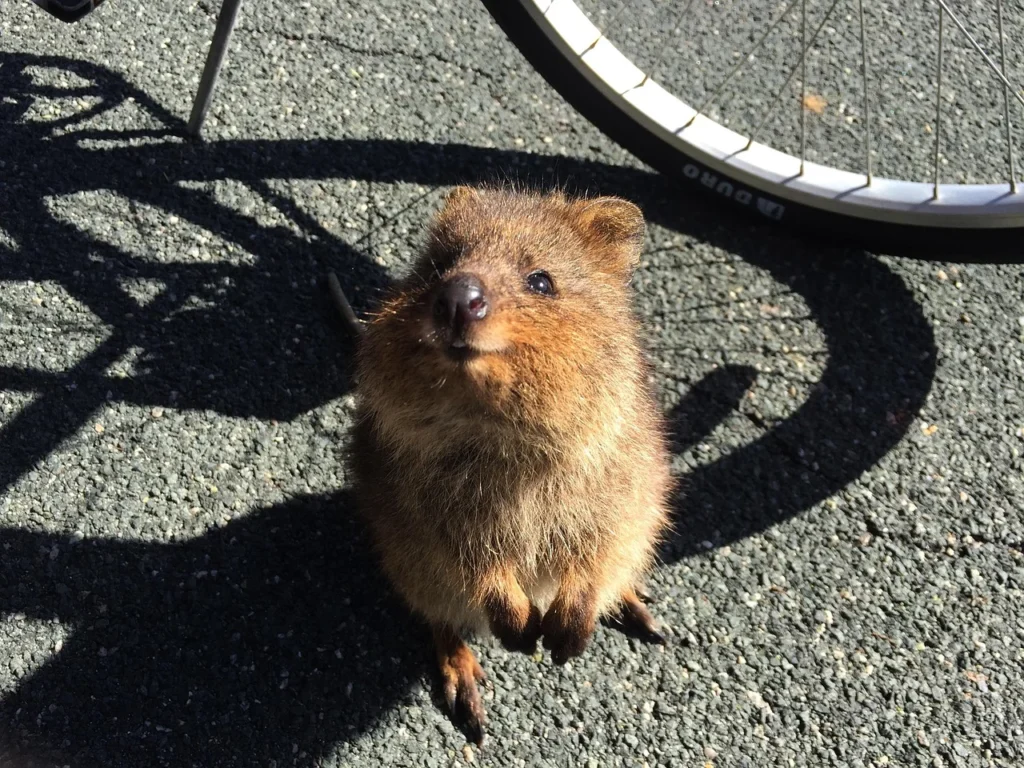
Quokka Pet Price
Since quokkas cannot be legally sold as pets, estimating a price is difficult. However, exotic animals similar in size, such as wallabies, can cost anywhere from $3,000 to $10,000 USD. If quokkas were legally available, their price would likely be in this range or even higher due to their rarity.
If you’re interested in small exotic animals, a Red Panda shares some similar care requirements with a quokka.
Care for Quokka as a Pet
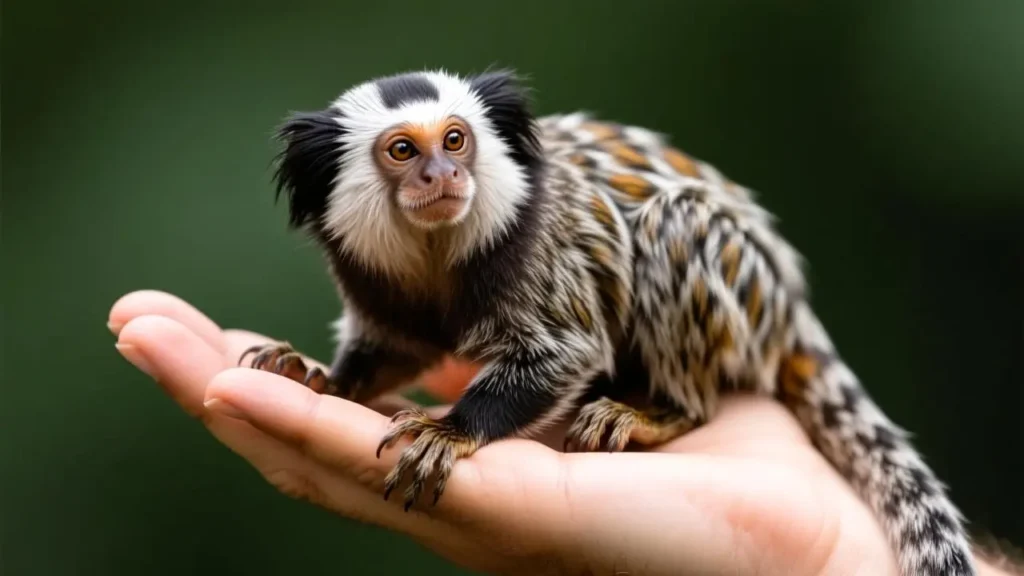
While quokkas are naturally friendly, they are still wild animals and have strict dietary needs that cannot be easily met in captivity. Their requirements resemble those of the marmoset monkey, which also struggles to adapt to household environments.
Habitat Requirements
Quokkas require a large, naturalistic habitat that closely mimics their native environment. Since they are primarily found in Australia’s southwestern forests and islands, their habitat should include:
- Ample space: A large, enclosed outdoor area is ideal.
- Shade and shelter: They need protection from extreme weather.
- Vegetation: Quokkas rely on various plants for food and cover.
- Climbing structures: Since they are semi-arboreal, they enjoy climbing.
Diet
Quokkas are herbivores, and their diet mainly consists of:
- Grasses and leaves
- Succulents and roots
- Bark and seeds
- Occasional fruits (but in small amounts, as too much sugar can be harmful)
Providing a proper diet is essential to their health. Processed human food is dangerous for quokkas and can lead to severe digestive issues.
Social Needs
Quokkas are highly social animals and thrive in the presence of others of their species. Keeping a single quokka alone could result in:
- Stress and depression
- Increased aggression
- Unnatural behaviors due to loneliness
Since they live in small groups in the wild, they require constant interaction with other quokkas to remain healthy and happy.
Veterinary Care
Caring for a quokka requires access to specialized veterinary services, which can be expensive and difficult to find. Key health concerns include:
- Nutritional deficiencies if not provided with the right diet.
- Stress-related illnesses from captivity and isolation.
- Infections and parasites that require professional treatment.
Legal Considerations
Owning a quokka as a pet is illegal in most places, including Australia and the United States. Laws protect quokkas because they are a threatened species, and removing them from their habitat disrupts their fragile ecosystem.
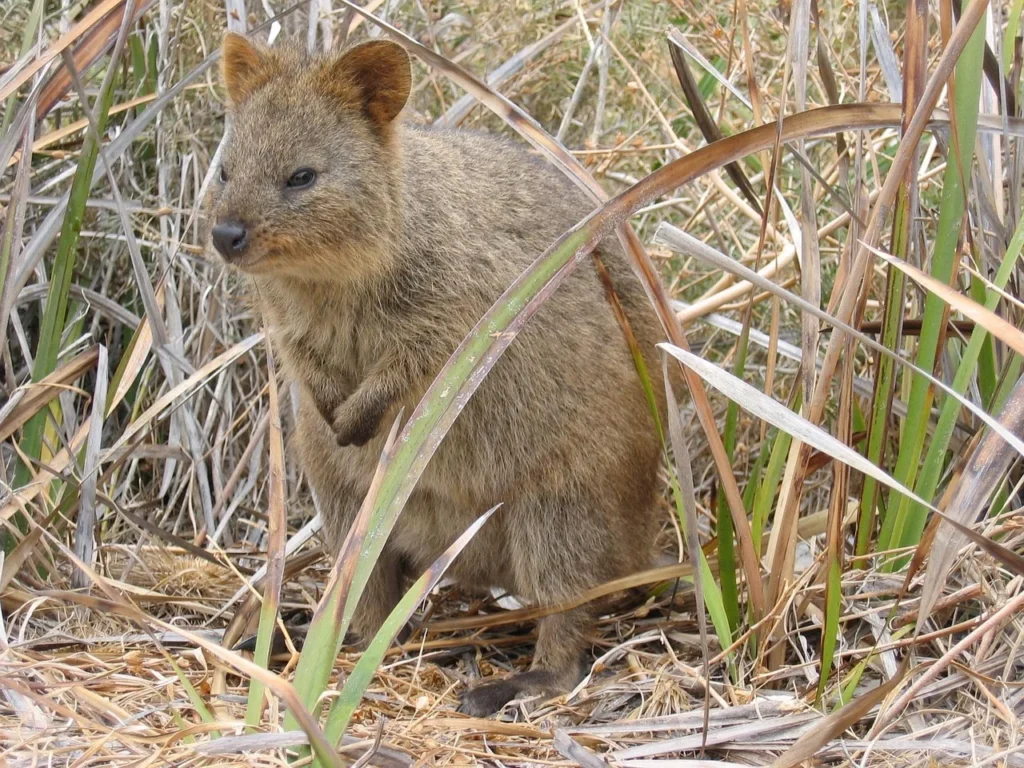
Quokkas are undeniably adorable, but legal restrictions and ethical concerns make owning one impractical. If you’re interested in other rare marsupials, read about Keeping a Kangaroo as a Pet.
The Cost of Taking Care of a Quokka
Even if quokka ownership were legal, their care would be incredibly expensive. The cost breakdown could include:
- Habitat setup: $5,000 – $10,000 (to mimic their natural environment)
- Veterinary care: $500 – $2,000 annually
- Food costs: $1,000 – $3,000 annually
- Permit fees (if legalized in the future): $500 – $2,000 annually
Hidden Costs of Owning a Quokka
In addition to the direct costs, there are hidden expenses such as:
- Specialized dietary requirements
- Climate control and habitat maintenance
- Legal complications and penalties for illegal ownership
Quokkas are wild animals that require specific environmental and social conditions to thrive. While they may seem friendly and adorable, keeping them as pets is neither ethical nor legal. If you love quokkas, consider visiting sanctuaries, supporting conservation efforts, or symbolically adopting one instead of trying to own one as a pet.
Are Quokkas Friendly to Humans?
Quokkas are naturally curious and are known to approach humans, particularly on Rottnest Island. However, this does not mean they are domesticated or should be kept as pets. While they may appear friendly, their behavior is largely motivated by the search for food.
Despite their friendly faces, quokkas belong in the wild. For a more accessible exotic animal, you might explore the Bat as a Pet.
Can Quokkas Get Aggressive?
Though quokkas are generally docile, they can get aggressive if they feel threatened or are mishandled. Their sharp teeth and claws can cause injury.
Can Quokkas Bite?
Yes, quokkas can bite if they feel stressed, provoked, or threatened. Despite their friendly demeanor, they remain wild animals.
Are Quokkas Tame?
Quokkas are not domesticated animals and cannot be tamed like a dog or cat. Even in wildlife sanctuaries, they retain their natural instincts.
What is the Lifespan of a Quokka?
In the wild, quokkas have a lifespan of 8 to 12 years. In captivity, they can live up to 15 years if cared for properly.
Why Do Quokkas Sacrifice Their Babies?
A commonly misunderstood fact about quokkas is their survival mechanism: when threatened by predators, a mother quokka may eject her baby (joey) from her pouch to distract the attacker while she escapes. This is a last-resort defense mechanism rather than intentional cruelty.
Why Are Quokkas Bad Parents?
This behavior has led to the misconception that quokkas are bad parents. However, in the wild, survival is their top priority, and abandoning a joey increases the mother’s chances of reproducing again.
What If a Quokka Touches You?
While quokkas may approach humans, touching them is strongly discouraged. On Rottnest Island, interacting with quokkas can result in fines of up to $300 AUD. Handling them can also expose them to harmful bacteria and stress.
Ethical Considerations of Quokka Ownership
Like marmoset monkeys, quokkas thrive in social environments and need companionship.
Conservation Concerns
Removing quokkas from their natural habitat could negatively impact their already declining populations. Conservation efforts focus on protecting their environment rather than domesticating them.
Human Impact on Quokkas
Tourism and human interaction with quokkas can stress the animals and lead to negative health effects. Feeding them human food, for example, can be harmful.
Conclusion: Should You Keep a Quokka as a Pet?
In short, no. Quokkas are wild animals, and it is illegal to keep them as pets. Their specialized care, social needs, and legal protection make them unsuitable for domestication. However, if you want to admire quokkas, visiting wildlife sanctuaries or supporting conservation efforts is the best way to appreciate these adorable creatures.
Alternatives to Owning a Quokka
For those who love quokkas but cannot own one, there are alternatives:
- Visit quokka sanctuaries to observe them in their natural habitat.
- Support wildlife conservation programs to help protect quokka populations.
- Adopt a quokka symbolically through organizations that use funds for conservation.
- Consider a legal exotic pet, such as a sugar glider or wallaby, which may be easier to care for in some regions.
By making responsible choices, we can ensure quokkas continue to thrive in the wild while still enjoying their unique charm.
If you love cute and friendly animals, you may also enjoy our article on Red Pandas as pets
Thanks for finally talking about > Quokka as a Pet: Care, Legalities, and Ownership Guide – The Animal Sound < Loved it!
Thanks for finally talking about > Quokka as a Pet:
Care, Legalities, and Ownership Guide – Animal Sound
< Loved it!