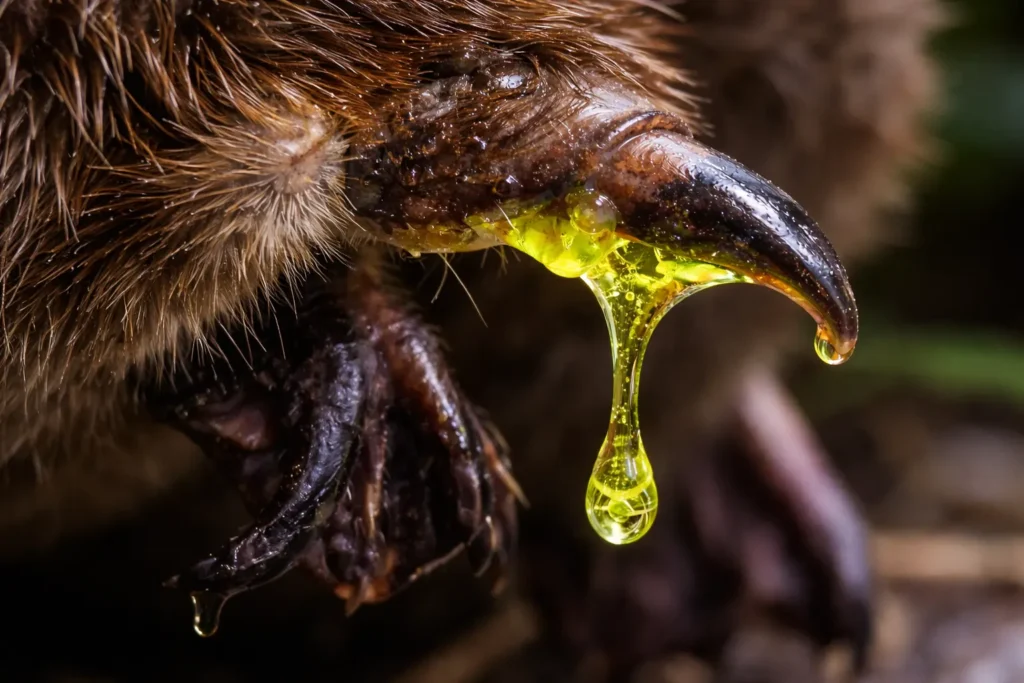
I’ll be honest. When I first started looking into platypus venom, I expected a boring answer. Small animal, mild venom, move on. What I actually found had me reading scientific papers until 2:00 AM three nights in a row.
Here is the part that stopped me cold: morphine doesn’t work on it. Not “works less well.” It just doesn’t work. If you get stung in Queensland, Australia and end up in hospital, the doctor cannot give you a standard opioid and send you home comfortable. The venom actively blocks those pain pathways. I’ve gone through the documented medical cases, and what victims describe is genuinely alarming for something the size of a house cat.
This is what the AI summary on Google won’t tell you. It will say “painful venom from hind leg spurs.” It won’t explain why that pain is unlike almost anything else in the animal kingdom, or what researchers are now doing with it that could actually change medicine.
Species: Ornithorhynchus anatinus Conservation Status: Near Threatened (IUCN) Found In: Eastern Australia and Tasmania only
Do Platypuses Actually Have Venom?
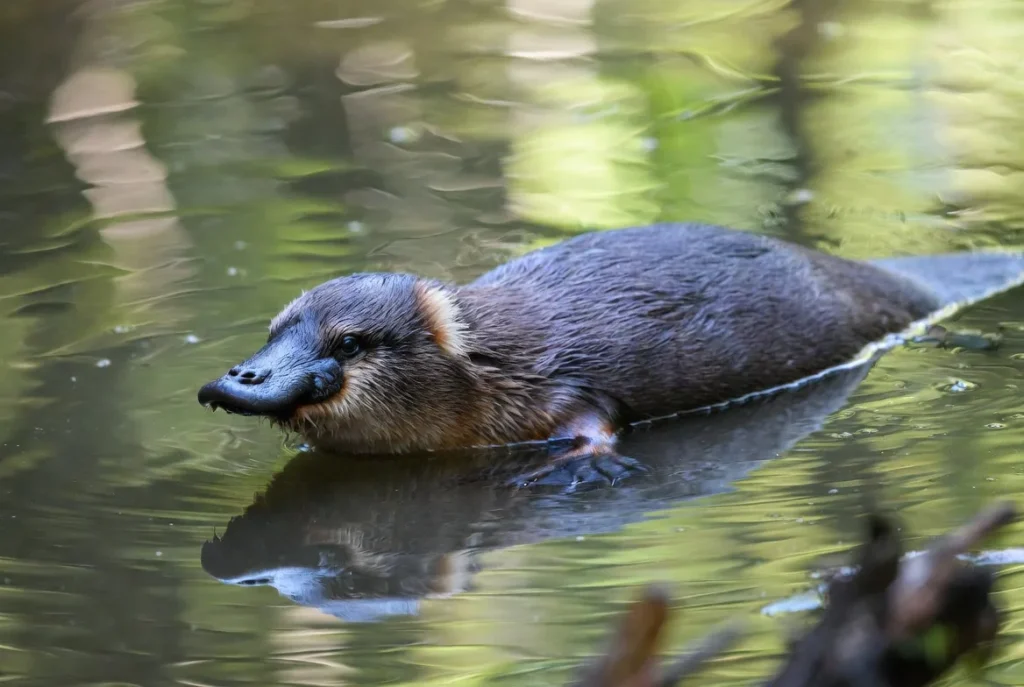
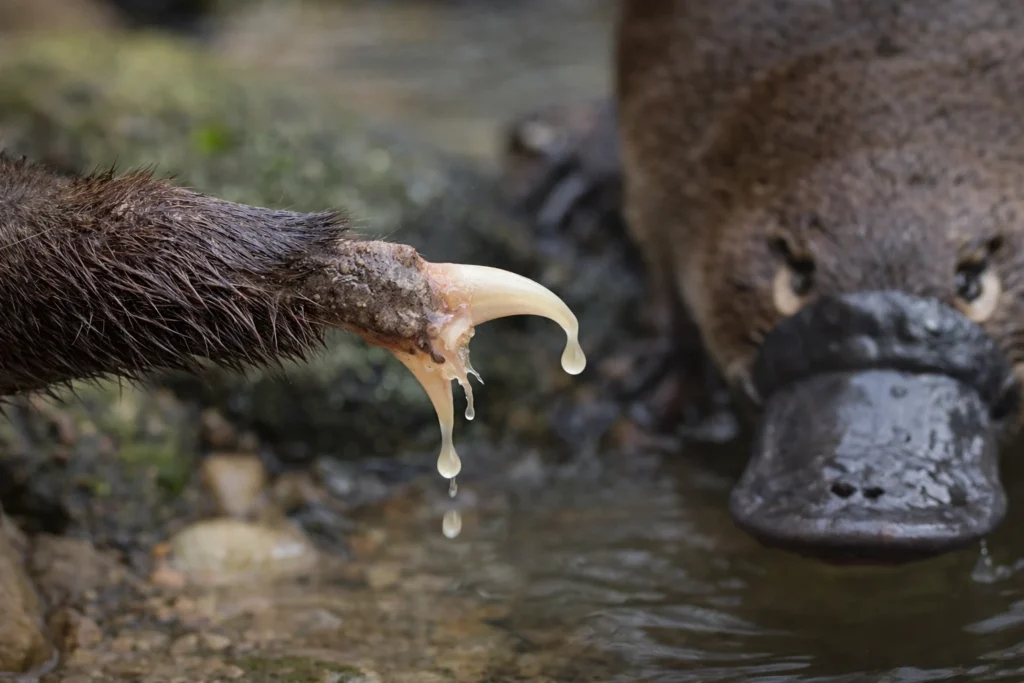
Yes, but only the males, and only from spurs on their hind legs. Not the bill. This surprises almost everyone.
Ornithorhynchus anatinus already looks like nature lost a bet. A duck bill, a beaver tail, otter feet, and electroreceptors in its snout that pick up the electric fields of prey underwater. Adding venom to that list feels like overkill. But it is real and well documented.
The venom comes from crural glands in the male’s thighs. Those glands connect through ducts to hollow spurs on the hind legs. The platypus does not passively drip venom. It has to physically press those spurs into something, which it mostly does during mating season fights with other males, or when it feels cornered.
Females are born with spur buds but they fall off in the first year. So if you are ever near a platypus in the wild, which almost certainly means you are in Australia, the only one that can hurt you is a male.
What Does Platypus Venom Do to Your Body?
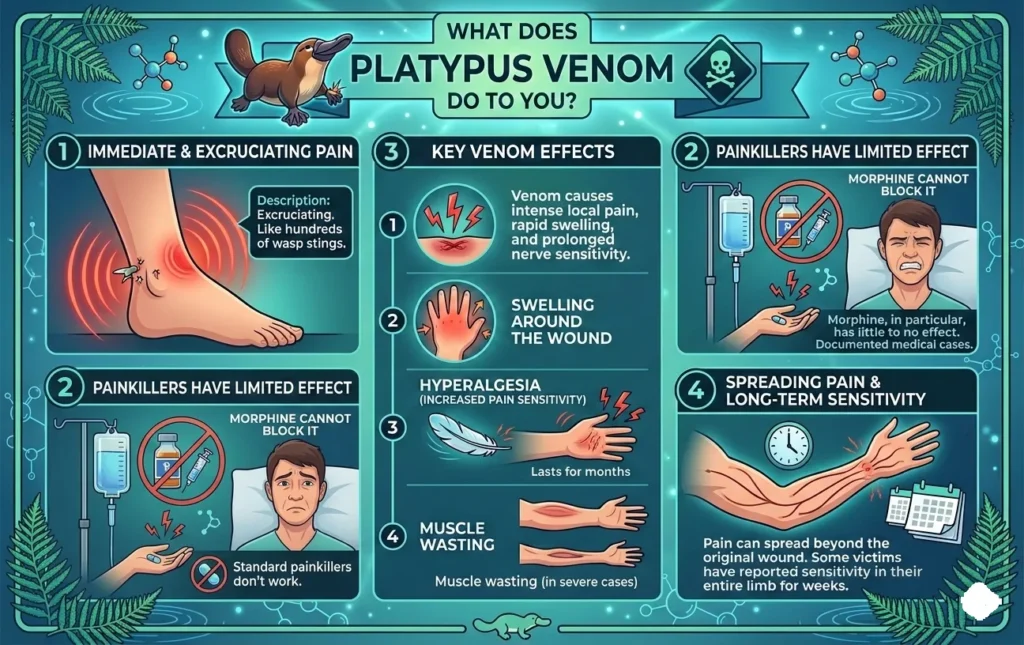
The pain starts almost immediately. Every account I’ve read from actual victims says the same thing: it is completely out of proportion to what you would expect from a 2 kilogram animal.
Some people describe it as hundreds of wasp stings hitting the same spot at once. Others describe a deep grinding sensation that spreads up the whole limb. One Australian wildlife researcher documented that he could not use his hand properly for four months after a single sting during fieldwork.
The venom contains at least 19 different proteins. Nerve growth factor, defensin-like peptides, C-type natriuretic peptides. Together they cause:
- Severe, immediate pain at the sting site
- Significant swelling around the wound
- Hyperalgesia, which is an abnormal sensitivity to pain that can spread to the entire limb and last for weeks or months
- Muscle wasting in serious cases
The hyperalgesia is what makes it medically unusual. The wound can look healed on the outside while the victim is still dealing with real pain weeks later. That is not how most animal venoms work.
Is Platypus Venom Stronger Than Morphine?
This is the question that pulled me deepest into the research.
The venom is not “stronger” than morphine in a general sense. It is resistant to it. Morphine works by binding to opioid receptors to block pain signals. Platypus venom activates pain pathways that those receptors simply do not cover.
Researchers found a peptide called DLP-4, which is structurally similar to defensin proteins found in reptiles. It interacts with pain receptors in a way that bypasses conventional opioid relief entirely. In documented hospital cases in Australia, standard painkillers provided almost no relief. Regional nerve blocks showed better results but were not always fully effective either.
Here is the part I found genuinely fascinating. Because the venom activates such unusual pain pathways, scientists are now studying those exact mechanisms to develop new painkillers for patients whose chronic pain does not respond to anything currently available. The thing that causes a strange kind of pain might eventually treat a strange kind of pain.
Can You Survive a Platypus Sting?
Yes. There are no recorded human deaths from platypus venom.
But surviving it is not easy. The cases I’ve read through describe people who were unable to grip objects for weeks and dealing with persistent pain for months. Secondary infection from the wound is also a real risk if you do not treat it quickly.
The honest picture: you will almost certainly survive. You will not be comfortable.
What to Do If You Get Stung by a Platypus
This is most likely to happen to someone in Australia, either during wildlife fieldwork or accidental contact while fishing. Here is the step-by-step based on current medical guidance:
- Get out of the water immediately. The venom can cause sudden muscle weakness. Drowning is a real risk if you are wading.
- Wash the wound with warm water, around 45 degrees Celsius or 113 Fahrenheit, for at least 20 minutes.
- Take ibuprofen or paracetamol as a first step, but know that these will likely give only partial relief.
- Do not squeeze the wound or try to remove the spur. This pushes venom deeper into the tissue.
- Do not apply a tourniquet or try to suck the wound. Neither helps.
- Keep the limb still and below heart level to slow the spread through the lymphatic system.
- Go to an emergency room immediately. There is no antivenom. Ask specifically about regional nerve blocks as they have shown better results than opioids for this type of venom.
- Follow up with your doctor. The hyperalgesia can last long after the wound looks healed.
If you are in the USA or UK and somehow encountered a platypus in a zoo or research setting and were stung, call 911 in the US or 999 in the UK. Tell them specifically it was a platypus sting because the treatment approach is different from standard venomous animal cases.
Can You Touch a Platypus Safely?
In controlled conditions with the right technique, technically yes. With a wild one, absolutely not. Wild platypuses are fast, shy, and have zero interest in human contact. If you corner one or startle it in shallow water, a male will use those spurs. It is not passive. A frightened male will press them in.
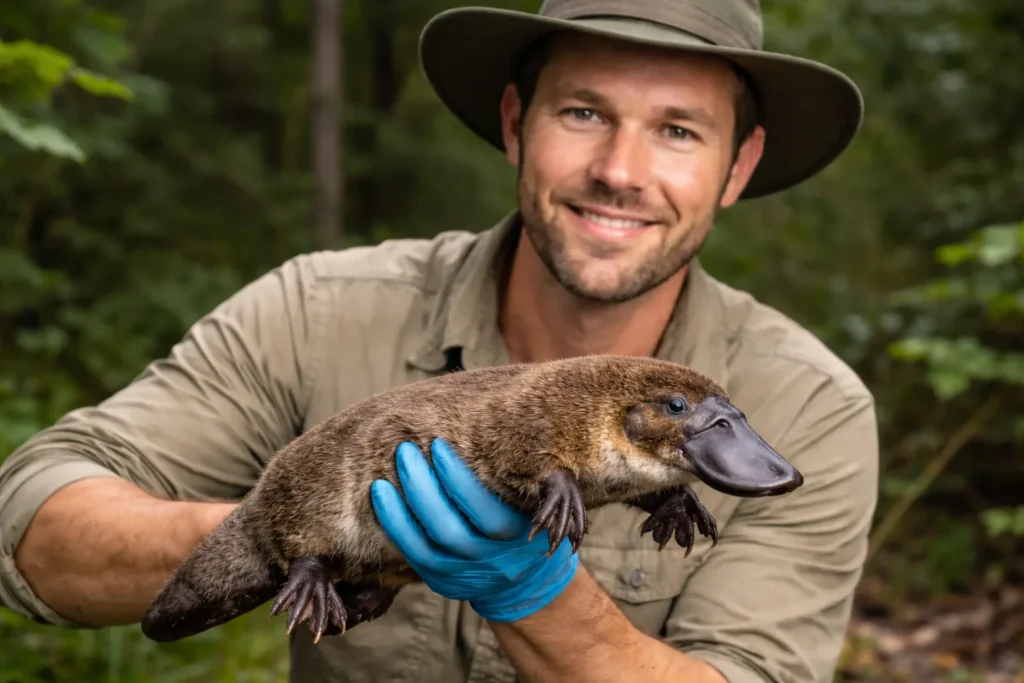
Even in Australian sanctuaries and research facilities, handlers use thick gloves and keep their hands clear of the hind legs at all times. The animals are not naturally aggressive. They are just unpredictable when stressed, and one wrong moment means months of pain. If you want to see a platypus up close safely, Healesville Sanctuary in Victoria, Australia has one of the best platypus viewing setups in the world. That is realistically as close as most people should get.
Platypus in captivity, handlers who work with platypuses use thick gloves and careful technique to avoid the hind legs. It’s not that the animals are aggressive by nature. They’re just unpredictable when stressed, and the consequence of getting it wrong is weeks of misery.
Are Platypuses Dangerous?
Not in a predatory way. They are not going to chase you. But not aggressive and harmless are two different things. A startled male platypus can put a grown adult out of action for months. The risk is real. It is just easy to avoid by not handling them.
For comparison: dogs injure millions of people every year worldwide. Documented platypus stings in humans number in the dozens across all of recorded history. The statistical risk is very low, but only because people generally do not handle them. The venom itself is serious.
But “dangerous Platypuses” is relative. A startled male platypus can deliver a sting that will put you out of commission for months. In that sense, yes, they carry a real risk. It’s just a risk that’s easy to avoid by leaving them alone.
How Much DNA Do We Share With a Platypus?
About 82%. That is less than we share with chimpanzees, which is around 99%, or even mice, which is around 85%, but it is still a significant overlap.
What makes platypuses genetically interesting is how ancient their lineage is. They are monotremes, one of the earliest branching points in mammalian evolution. They lay eggs, produce milk without nipples, use electroreception to hunt, and have ten sex chromosomes. Humans have two. Their genome mixes mammalian, reptilian, and avian traits that have helped researchers understand how those features evolved over hundreds of millions of years.
Is It Legal to Own a Platypus in the US, UK, or Australia?
Is it Legal to Own a Platypus? No, in any of these countries.
Australia: Platypuses are protected under the Environment Protection and Biodiversity Conservation Act 1999. Private ownership is not legal. The only exceptions are licensed zoos and specific conservation research institutions.
USA: Because platypuses cannot be legally exported from Australia, there is no legal path to private ownership in the US. They are also covered under CITES regulations. You can check the specifics at fws.gov.
UK: The Dangerous Wild Animals Act 1976 combined with CITES import restrictions makes private ownership impossible in practice.
If you are curious about what exotic animals you can legally keep, check out our guide to platypus care and price tags and our full breakdown of is it legal to own a platypus for a country by country look.
What Would a Platypus Cost, Hypothetically?
There is no legal platypus price anywhere in the world for private purchase. Zoos that hold platypuses get them through formal conservation agreements with Australian wildlife institutions. No price tag, no pet store, no online listing.
Even setting aside the legal side, the care requirements alone would make it almost impossible for a private owner. Platypuses eat up to 20% of their body weight every single day in live invertebrates. Freshwater shrimp, insect larvae, worms. Major zoos with dedicated teams and serious budgets struggle to keep them healthy long-term. A private owner has no realistic chance.
They eat enormous amounts! up to 20% of their body weight daily. Platypus diet in the wild consists of insect larvae, worms, shrimp, and other small invertebrates. Replicating that in captivity is a serious challenge. Even major zoos struggle to keep them healthy long-term.
Where to Find Platypuses for Sale?
If you have been searching for platypuses for sale, I want to be straightforward with you. There is no legal source anywhere in the world. No pet store, no private breeder, no online marketplace. Any listing claiming to sell one is either a scam or illegal.
Your real options if you want to connect with platypuses:
Symbolically adopt one through WWF Australia at wwf.org.au, where your contribution supports active conservation work
Visit Healesville Sanctuary in Victoria, Australia, which has a dedicated platypus habitat open to the public
Fun Facts About Platypus Venom in Research
Platypus venom is turning into a serious area of biomedical research, for two very different reasons.
Type 2 Diabetes Treatment: The venom contains a hormone called GLP-1, which stands for glucagon-like peptide-1, and it plays a role in stimulating insulin production. The platypus version is much more resistant to breaking down in the body than the human version, meaning it stays active far longer. Researchers are looking at this as a possible basis for more effective type 2 diabetes treatments.
New Painkillers: Because platypus venom activates pain pathways that opioids cannot block, scientists are mapping those exact mechanisms hoping to find new treatment options for chronic pain patients who do not respond to current medications.
The platypus’s Near Threatened conservation status makes this research genuinely urgent. Losing this species could mean losing these discoveries before they are ever fully understood.
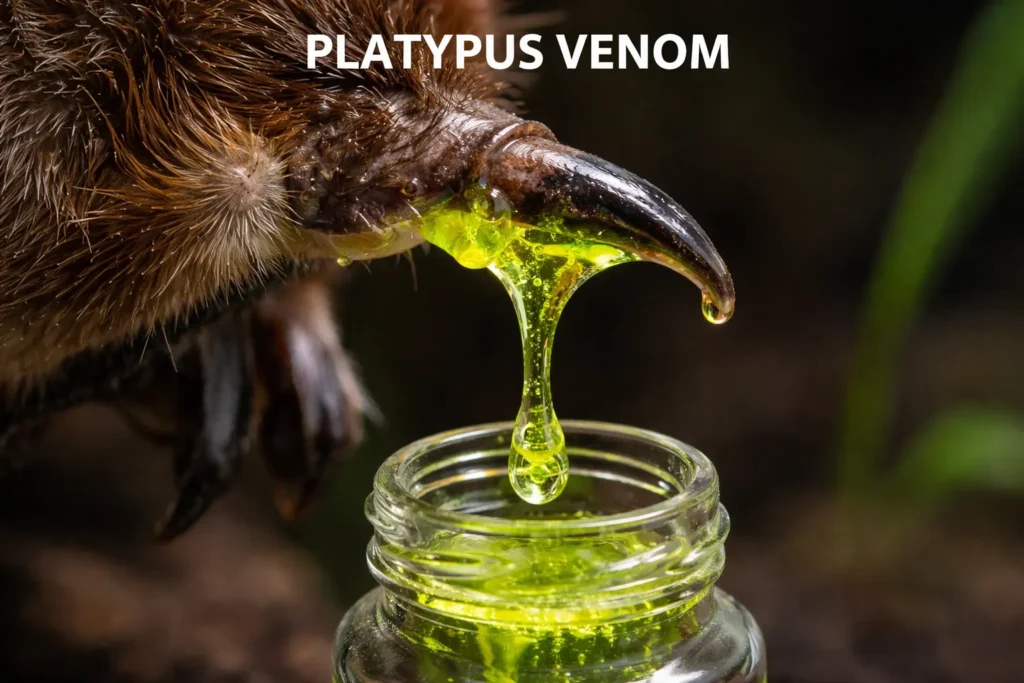
So while these animals may be nature’s oddest creature, its venom could one day contribute to medical breakthroughs that help millions of people worldwide. This makes the platypus endangered status all the more alarming, losing this species could mean losing discoveries before they ever reach patients.
Venom vs. Painkillers Comparison
| Sting/Bite Type | Primary Pain Mechanism | Resistance to Morphine | Long-Term Side Effect |
| Common Wasp | Histamines / Local tissue irritation | Low | None |
| Platypus Spur | DLP-4 Peptides / Nerve pathway activation | EXTREME | Hyperalgesia (Months) |
Final Thought
Platypuses have been confusing scientists since the 1790s. The first specimen sent to England was assumed to be a taxidermy hoax stitched together from different animals. That reaction makes sense. Almost everything about them seems impossible.
The venom is the clearest example. It does not kill you. It has no antidote. It defeats morphine. And it might eventually help treat both diabetes and chronic pain.
Leave them alone in the wild, do not try to own one, and keep an eye on the research coming out of Australian and American universities. Something useful is being built from that venom.



Pingback: Are Platypuses Dangerous to Humans? - Animal Sound
Pingback: Platypus Care and Price Tags - Animal Sound
Pingback: Is it Legal to Own a Platypus? - Animal Sound
Pingback: Can Platypus live in Captivity? - Animal Sound
Pingback: How Do Platypuses Live? - Animal Sound
Pingback: What Do Platypus Eat? - Animal Sound
Pingback: Can You Own a Pet Platypus? - Animal Sound
Pingback: Are Platypuses Extinct? Here's What's Actually Going On - Animal Sound
Pingback: Platypuses for Sale: Can You Actually Buy One as a Pet? - Animal Sound