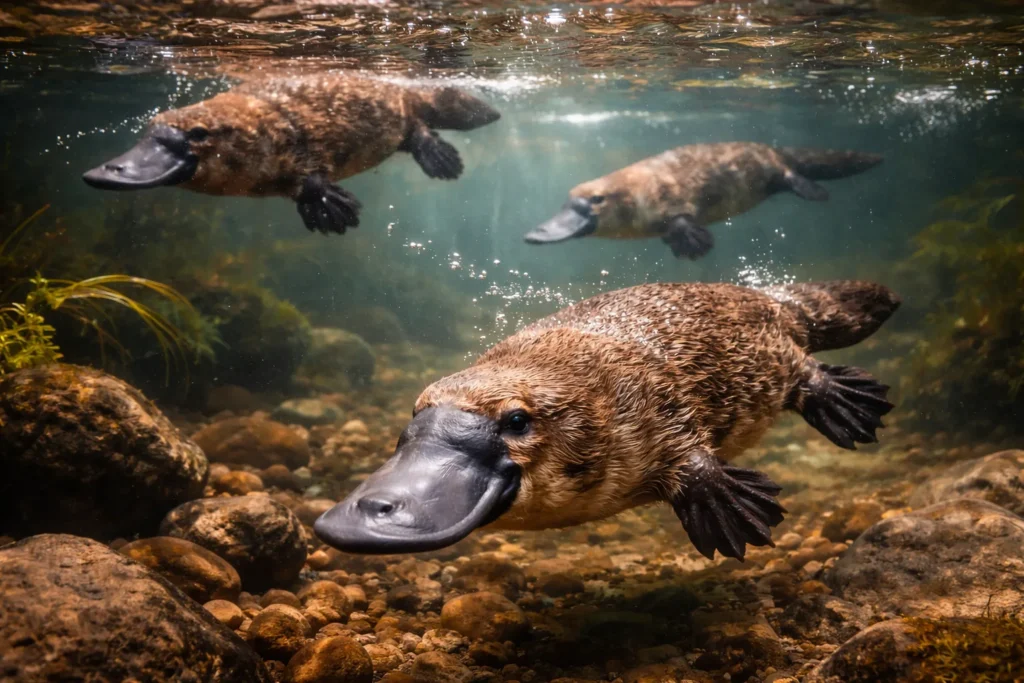
No, platypuses are not extinct. But here’s the thing, they’re not doing great either. These odd little creatures are still out there, swimming through the rivers of eastern Australia and Tasmania. They’re alive. They’re real. And they’re every bit as weird as you’ve heard.
That said, the platypus is now listed as a near-threatened species, and scientists are genuinely worried. So if you’ve been googling “are platypuses extinct” out of concern, your instincts aren’t wrong. Something is happening to them. Let’s get into it.
Is the Platypus Endangered?
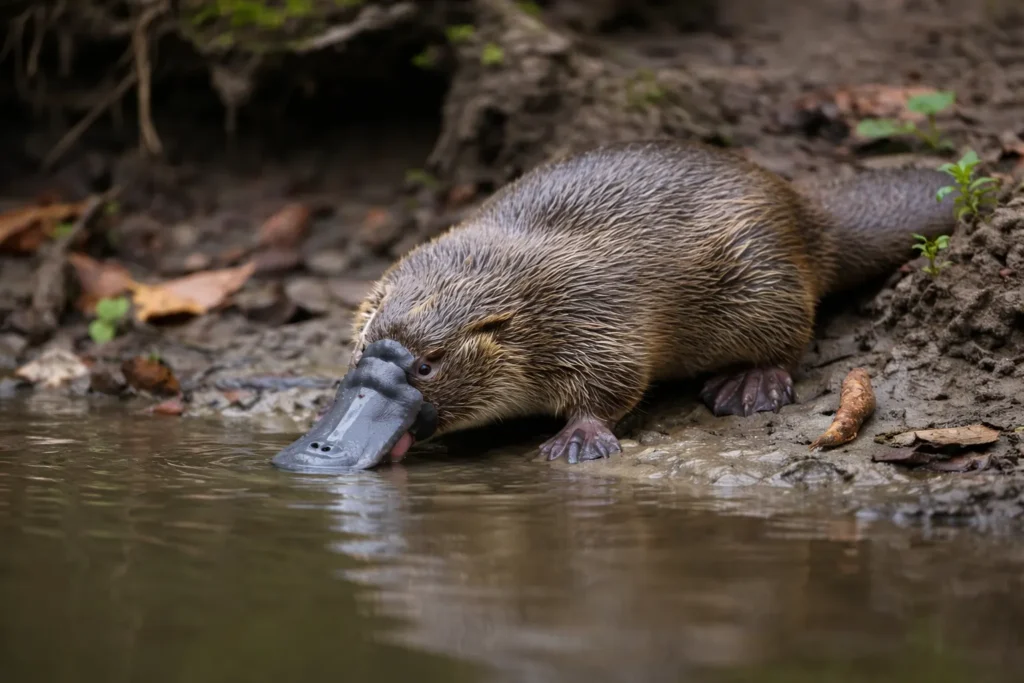
Here’s where things get a little concerning. The platypus is classified as “near threatened” on the IUCN Red List. It was only moved to this category in 2016, and researchers have since pushed for it to be reclassified as vulnerable or even endangered.
Why is the platypus endangered — or close to it?
- Habitat loss. Land clearing, dam construction, and changes to waterways have seriously reduced where platypuses can live.
- Drought. Australia’s increasingly severe droughts are drying up rivers and streams that platypuses depend on.
- Invasive species. Foxes, dogs, and cats prey on them, especially on land.
- Climate change. Warmer temperatures and altered rainfall patterns are shrinking their habitat fast.
One study from 2020 estimated that the platypus population had dropped by about 30% over the past 30 years. That’s not extinction — but it’s a real warning sign.
How Many Platypuses Are Left?
This is the big question. And the honest answer is: we don’t know exactly.
Estimates range from around 300,000 individuals down to as low as 30,000, depending on the study. The wide range reflects how hard they are to survey — they’re small, nocturnal, and live in remote river systems.
What we do know is that the numbers are declining. Habitat destruction and climate change are the biggest culprits. Some researchers have called for emergency conservation action before the situation gets worse.
What Even Is a Platypus?
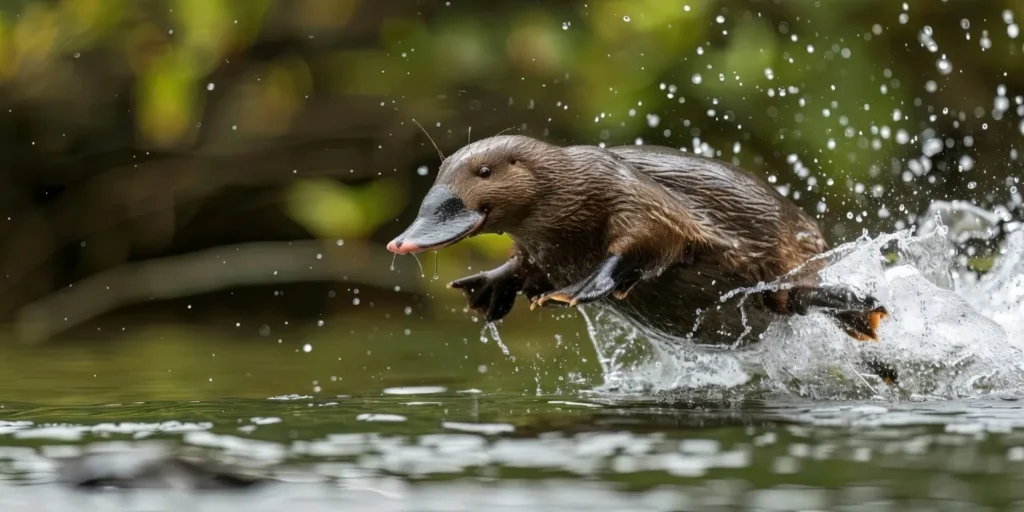
Okay, quick reality check. The platypus looks like nature couldn’t make up its mind. It has the bill of a duck, the body of an otter, a beaver’s flat tail, and webbed feet. A duck and platypus? Sure, people mix them up visually — but they’re completely different animals.
The platypus is a mammal. A very strange one. It’s one of only five species of monotremes — mammals that lay eggs instead of giving birth to live young. The other four are echidnas. That’s it. That’s the whole club.
And yes, the platypus and duck comparison makes sense on the surface. Both have bills. Both love water. But a platypus has fur, hunts underwater using electrical signals, and (in the case of males) carries venom. A duck does none of those things.
Platypus in the Wild — Where Do They Actually Live?
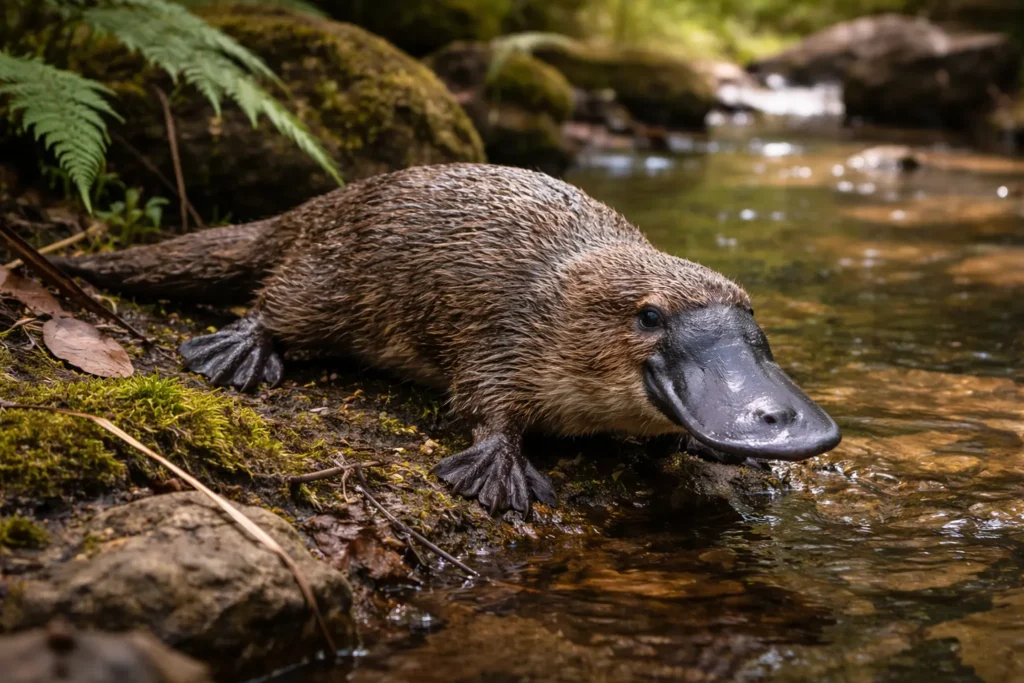
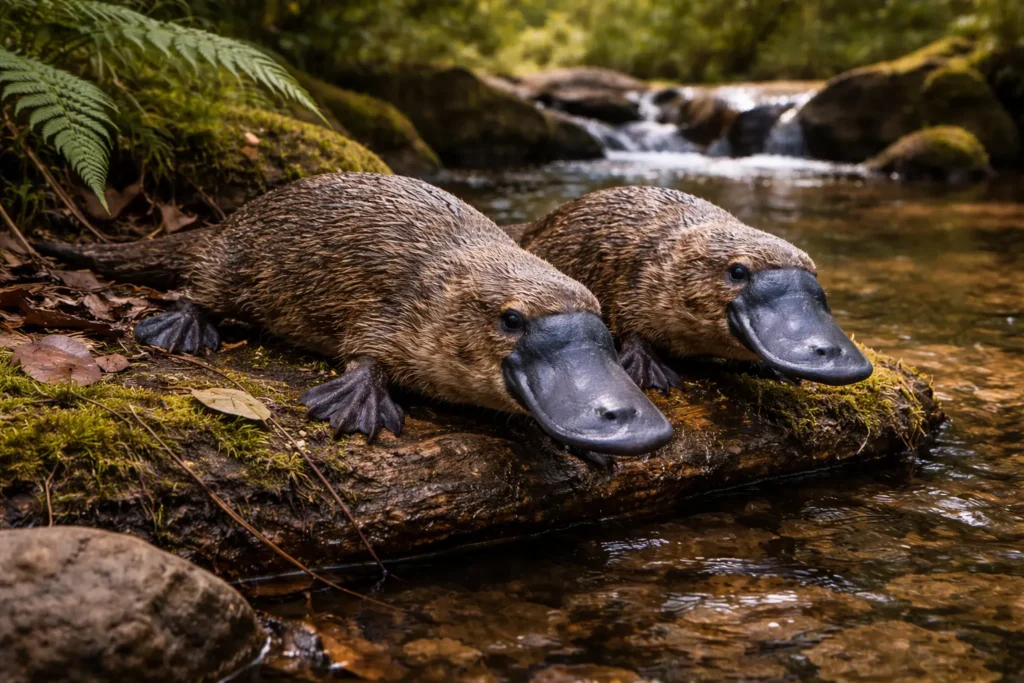
Platypus in the wild are found along the freshwater rivers, lakes, and streams of eastern Australia — from Queensland all the way down to Tasmania. They need clean, cool water to survive. They burrow into riverbanks and spend a good chunk of their day swimming and hunting.
Seeing a platypus in the wild is genuinely rare. They’re shy, mostly nocturnal, and move fast in water. If you do spot one, count yourself lucky.
Where are platypus found?
- Eastern and southeastern Australia
- Tasmania
- Some parts of South Australia (via reintroduction programs)
They don’t exist naturally anywhere else on Earth. You won’t find them in the wild in Europe, Asia, or the Americas. They’re uniquely Australian — almost like the country’s unofficial mascot.
Read More : Are Platypuses Dangerous to Humans?
Do platypus eggs?— Yes, Really
Let’s talk about something that still trips people up: platypus eggs.
Despite being a mammal, the female platypus lays eggs. Typically one to three at a time. The eggs are soft and leathery, a bit like reptile eggs, and she incubates them by curling around them in her burrow. After about 10 days, the eggs hatch. The tiny, blind babies — called puggles — then feed on milk. But here’s the twist: the female platypus has no nipples. Instead, milk seeps through patches of skin on her belly, and the puggles lap it up.
This makes the platypus the answer to a great trivia question: which animal gives both egg and milk? The platypus. (Echidnas also do this, but the platypus gets most of the attention.)
Is a Platypus Poisonous? Actually — Yes
Most people don’t know this, but the platypus is poisonous. Sort of.
To be precise, the male platypus has a spur on each of his hind legs connected to a venom gland. During breeding season especially, he can deliver a painful sting. It won’t kill a human, but it causes severe, long-lasting pain that even strong painkillers can barely touch.
The female platypus has the same spur as a juvenile but loses it as she matures. So adult females are venom-free.
Why does the male platypus have venom? Scientists think it’s used in competition with other males during mating season. It’s not a hunting tool — platypuses eat small invertebrates, not animals they need to subdue with poison.
The Platypus Foot
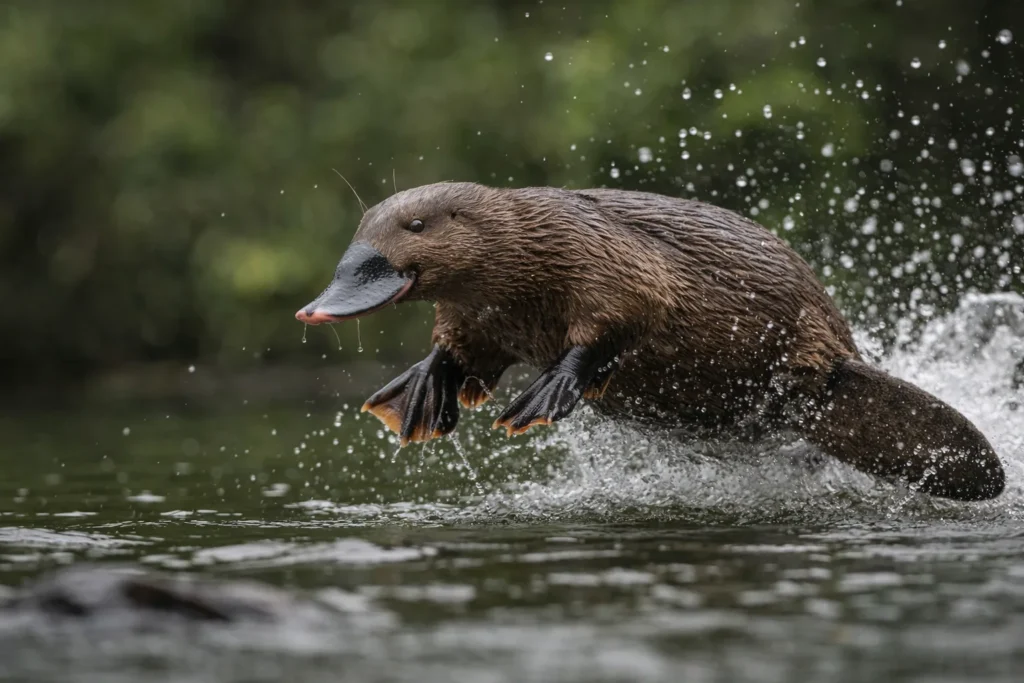
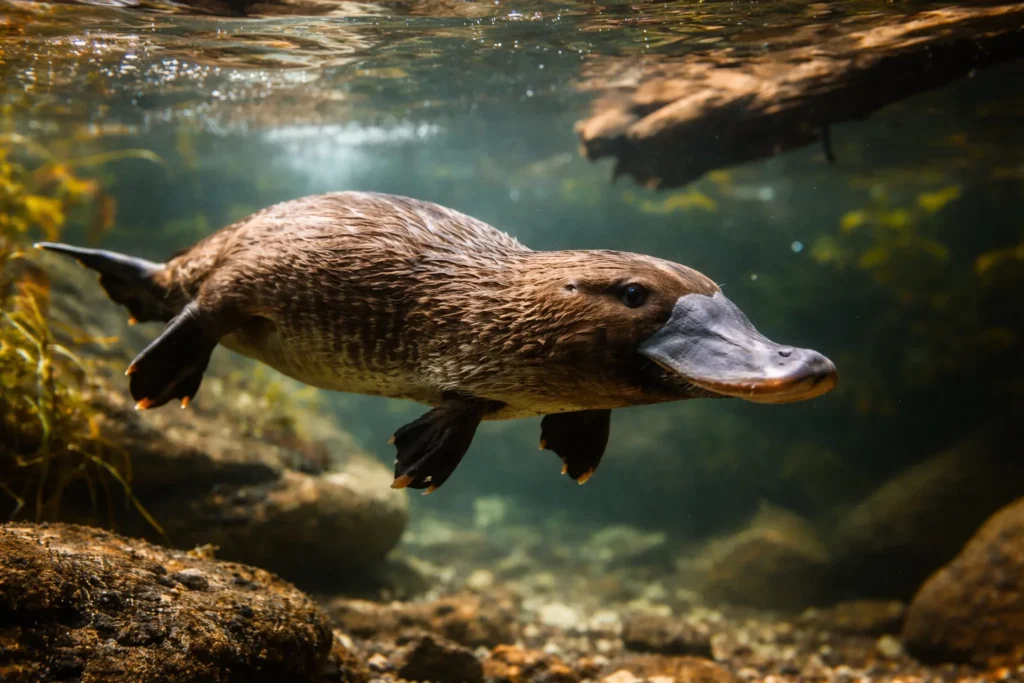
The platypus foot is genuinely fascinating. On land, the platypus walks on its knuckles — the webbing folds back so it can actually grip the ground. In the water, that same webbing spreads out and works like a paddle.
The hind feet are slightly different from the front. The males’ rear spurs (those venomous ones) sit on the hind legs. The front feet do most of the digging when building burrows.
Platypus on land is actually a bit awkward — they shuffle along and don’t move fast. But in the water? Completely different. They’re smooth, fast, and weirdly graceful for an animal that looks like a mashup of several others.
Can You Have a Pet Platypus?
Let’s address this one clearly: you cannot legally own a pet platypus.
The pet platypus question comes up a lot online, and it makes sense — they’re adorable. A cute platypus is genuinely one of the most charming-looking animals on the planet. But they’re protected under Australian law and cannot be exported or kept as pets, even in Australia.
Even platypus in a zoo situations are extremely rare. Only a handful of zoos in the world successfully keep them because the animals are so sensitive to their environment. They need specific water temperatures, diet conditions, and space to behave naturally.
What’s the platypus price in terms of captivity? You can’t buy one — it’s not a matter of money. It’s illegal. End of story.
Platypus Diet — What Do They Actually Eat?
Platypus diet is interesting because they hunt almost entirely underwater and entirely by feel and electrical signal — not sight or sound.
They eat:
- Insect larvae
- Worms
- Shrimp
- Yabbies (freshwater crayfish)
- Small fish eggs occasionally
They have no teeth. Instead, they use hard, keratinous pads in their bill to grind up food. They also have to eat roughly 20% of their body weight in food every day. That’s a lot of worms.
When hunting, the platypus closes its eyes, ears, and nose and relies entirely on the electroreceptors in its bill. It can detect the tiny electrical impulses created by the muscle contractions of its prey. Wild, right?
Male vs. Female Platypus — What’s the Difference?
Besides the venom situation, male platypus and female platypus differ in a few notable ways.
The male is larger — typically 50cm or more in length, while females are usually around 43cm. The male also has that venomous hind spur. The female handles all the parenting alone; she builds the nesting burrow, incubates the eggs, and nurses the young by herself.
There’s no pair bonding in platypuses. Once mating is done, the male moves on. Classic platypus.
Does a Platypus Look Like a Duck?
Honestly? Kind of. Does a platypus look like a duck? If you squint. They both have wide, flat bills. But a platypus is furry, four-legged, and much smaller than most ducks. A duck is a bird. A platypus is a mammal. They’re not even remotely related — the resemblance is pure coincidence.
The duck and platypus comparison is mostly a fun way to confuse people at pub quizzes. They evolved their bills independently for completely different reasons. The duck’s bill is for filtering food. The platypus bill is a sensory organ.
Are Platypuses Related to Ducks?
Are platypus related to ducks? No. Not even close. Ducks are birds. Platypuses are mammals — specifically monotremes, one of the oldest mammal lineages on Earth. Their last common ancestor with birds was hundreds of millions of years ago. The bill is a coincidence of convergent evolution, not a sign of relation.
Platypus in a Zoo
Platypus in zoo environments are incredibly rare globally. In Australia, a few wildlife parks — like Healesville Sanctuary in Victoria — have successfully housed them. Outside Australia, it’s almost impossible to find one. If you ever get the chance to see one at a zoo or sanctuary, go. Watching a cute platypus hunt underwater through a glass tank is genuinely one of the stranger, more magical experiences nature offers.
People Also Ask
Are platypus related to ducks?
No. Ducks are birds; platypuses are mammals. Their similar-looking bills evolved independently for completely different reasons. They share no close evolutionary relationship.
Which animal gives both egg and milk?
The platypus — and echidnas. Both are monotremes, mammals that lay eggs but nurse their young with milk.
Does a platypus look like a duck?
Somewhat, in that both have flat bills. But platypuses are furry, four-legged, and mammalian. The resemblance is superficial.
How many platypus are left?
Estimates vary widely — from around 30,000 to 300,000 individuals. The population is declining due to habitat loss, drought, and climate change.
Where are platypus found?
the wild, platypuses are only found in eastern Australia and Tasmania. They live in and around freshwater rivers, lakes, and streams.
Final Thoughts
So — are platypuses extinct? No. But they need our attention. They’re weird, wonderful, and genuinely unlike anything else on Earth. A mammal that lays eggs, produces milk, hunts with electricity, and packs venom in its feet. That’s not science fiction. That’s just a platypus.
The fact that we might lose them to habitat destruction and climate change would be a real loss — not just for Australia, but for the entire story of life on this planet. They’ve been around for at least 100 million years. They deserve better than a quiet disappearance.


Pingback: Can You Own a Pet Platypus? - Animal Sound
Pingback: What Do Platypus Eat? - Animal Sound
Pingback: Can Platypus live in Captivity? - Animal Sound
Pingback: Is it Legal to Own a Platypus? - Animal Sound
Pingback: Platypus Care and Price Tags - Animal Sound
Pingback: Platypus Venom: What It Does, How Dangerous It Is! - Animal Sound
Pingback: How Do Platypuses Live? - Animal Sound