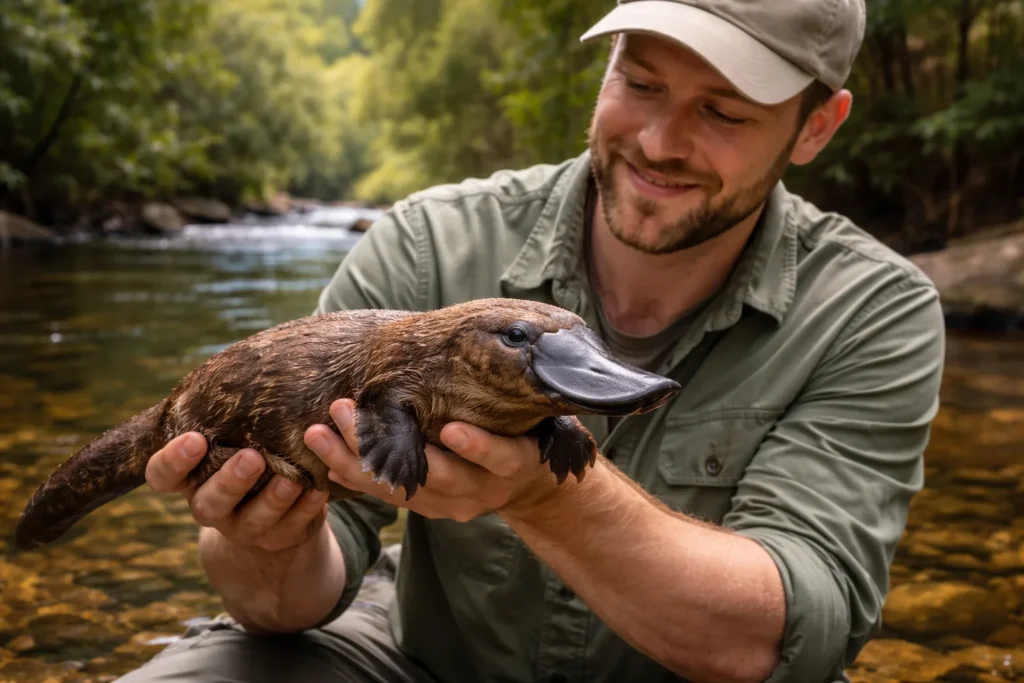
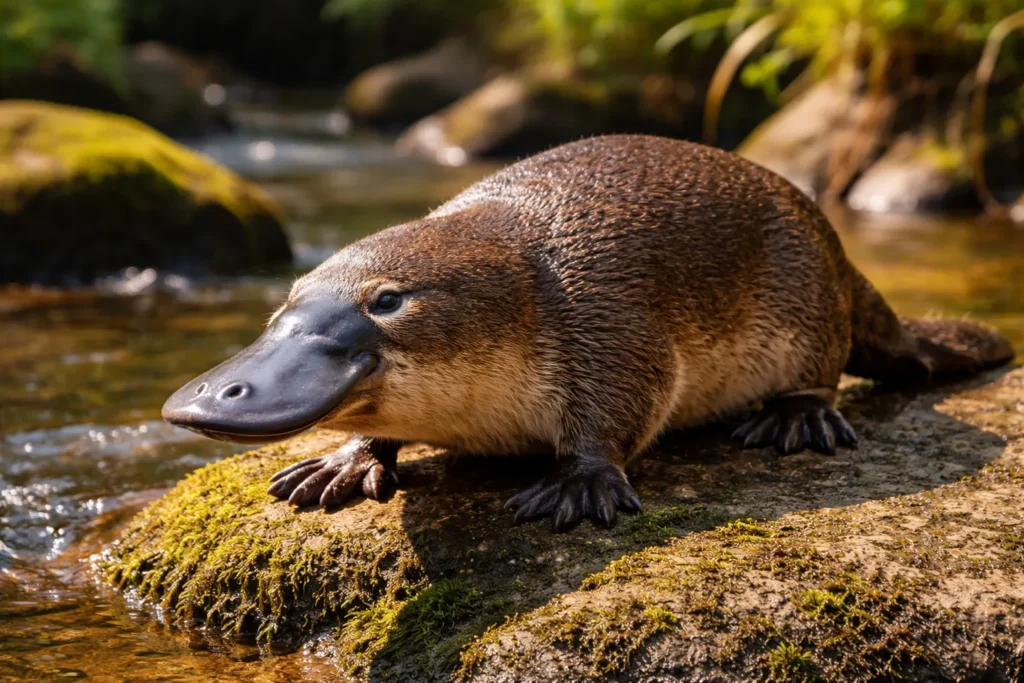
Are platypuses dangerous? For most people, the answer is no. These shy, duck-billed, otter-tailed mammals aren’t looking for humans to attack. In fact, no human has ever been killed by a platypus. However, male platypuses do have venomous spurs on their hind legs, and if you happen to provoke one (for example, by trying to pick it up), its sting can be agonizingly painful. Generally, though, platypuses will dive away and flee rather than fight. So unless you force the issue, this quirky critter isn’t on the prowl for people.

Can a Platypus Hurt You?
Here’s the honest answer: yes, a platypus can hurt you, but only under specific circumstances.
Platypuses don’t have teeth. They can’t bite you in any meaningful sense. What they can do is drive a hollow, venomous spur into your skin using their hind legs, and that’s a different story entirely. Only male platypuses have functional venom spurs, and they typically only deploy them during mating season or when they feel threatened. Outside those situations, they’re shy, reclusive little creatures that will almost certainly swim away before you even notice them.
But if you do happen to get on the wrong side of a male, say you’re a fisherman who accidentally handles one, or someone who’s trying to rescue a wild platypus — the spur acts like a needle. It doesn’t feel like much at first. Then the venom kicks in.
The pain has been described as “immediate, sustained, and devastating.” There’s swelling around the wound that can last for weeks. Nausea, cold sweats, lymph node swelling, and in more severe cases, low blood oxygen and convulsions. And here’s the truly unsettling part: standard painkillers don’t touch it. Not ibuprofen, not codeine, not even morphine. Doctors have to use nerve blockers — a class of drugs normally reserved for more serious interventions — just to manage the symptoms.
Read more : Platypus Care and Price Tags
It’s not lethal to healthy adult humans. No one has ever died from a platypus spur. But it’s absolutely not something you want to experience.
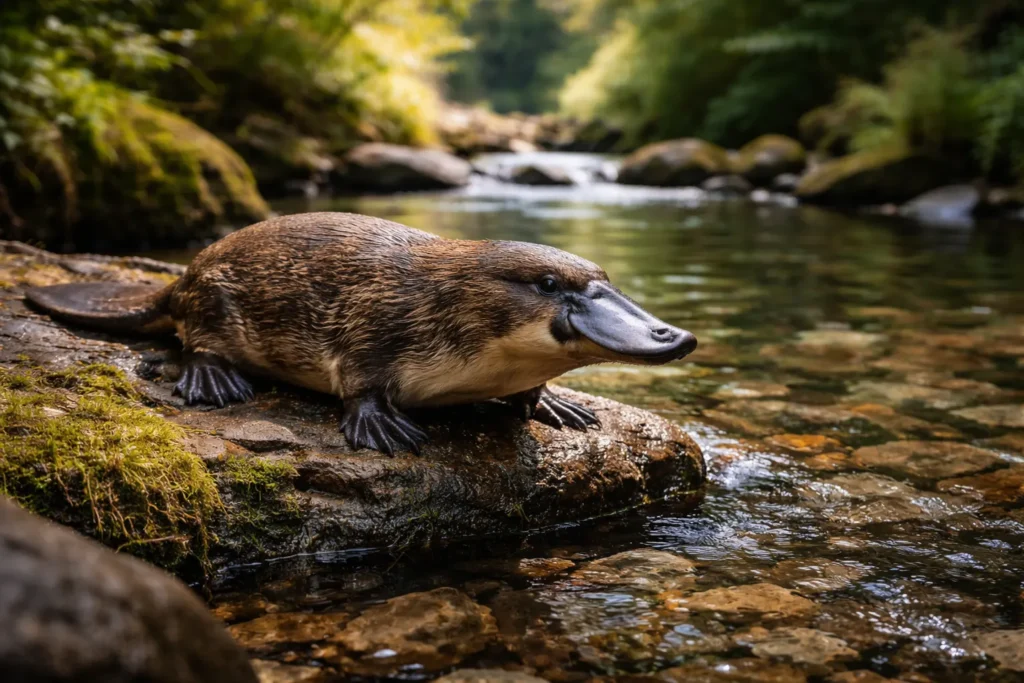
Platypus Venom Pain: What Actually Happens Inside Your Body
The venom itself is a cocktail of at least 19 different peptide groups. That’s a surprisingly complex chemical profile for an animal that looks like a nature documentary mashup of four different creatures. Scientists have found that several of these peptides are similar to those found in reptile venom — not because platypuses and reptiles share a close ancestor, but because of convergent evolution: completely unrelated species arriving at similar solutions to similar problems.
What makes Platypus venom pain so uniquely awful is how it works on the nervous system. It disrupts nociception, the body’s pain regulation system — in a way that essentially turns the volume all the way up and leaves it there. The pain isn’t just sharp. It radiates. It spreads. And it can linger for weeks, sometimes accompanied by muscle wasting in the envenomated limb.
There’s also a notable risk of secondary infection. A 2023 case study described a woman who came into the ER after handling an injured wild platypus. Her hand was infected with bacteria from the spur wound, including one strain that couldn’t even be identified. She needed IV antibiotics, surgery, and a three-month recovery. The platypus venom itself was bad enough; the spur is also, essentially, an unsterile puncture wound.
What Does the Venom Contain?
Three main groups of toxins define platypus venom:
- Defensin-like peptides (OvDLPs): Related to immune system proteins, these have been co-opted over millions of years of evolution to cause pain and disrupt cell membranes.
- C-type natriuretic peptides (OvCNPs): These mess with blood pressure regulation and contribute to swelling.
- Nerve growth factor (OvNGF): This one influences how pain signals are transmitted, and it’s part of why conventional painkillers fail so completely.
Here’s an interesting twist, though. Researchers have found that platypus venom also contains a form of GLP-1 — glucagon-like peptide-1, the same hormone that underpins a class of diabetes medications including some you may have heard of in recent years. Scientists are actively exploring whether the platypus venom could help refine or improve treatments for Type 2 diabetes. Nature, in its typically weird way, may have given us both a miserable injury and a potential medical breakthrough in the same small, furry package.
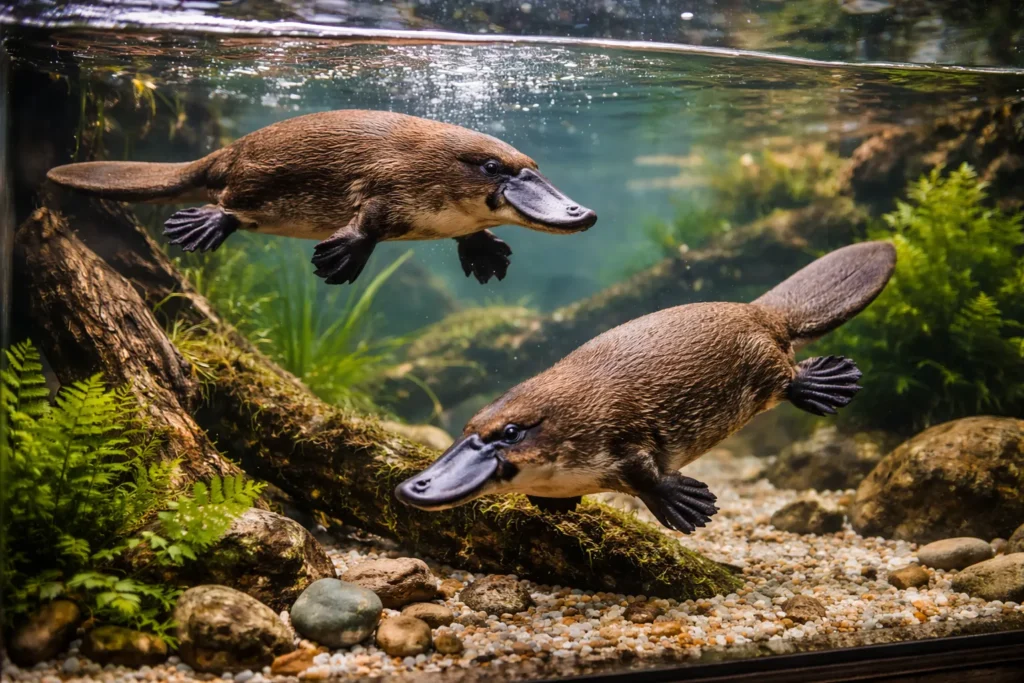
Are Platypuses Aggressive?
Not inherently, no. That’s actually one of the more important things to understand about them.
Platypuses are naturally shy, solitary animals. They spend most of their time underwater, hunting for insect larvae, worms, and crayfish with their sensitive bills. They’re not territorial toward humans in the way that, say, a cassowary or a saltwater crocodile might be. They’re not going to approach you, threaten you, or act with intent.
But and this is the key word males can become genuinely dangerous during mating season, which typically runs from June to October. During this period, the venom glands swell to several times their off-season size, producing up to 4 millilitres of venom. The males use their spurs aggressively against rival males to establish dominance. They wrap their legs around a competitor and drive the spurs in with considerable force.
If a human accidentally intrudes on that biological urgency, by handling a platypus, surprising one in the water, or trying to help an injured one, the same defensive response can be triggered. So while platypuses are not aggressive toward humans by nature, a threatened or breeding-season male is genuinely dangerous. That’s an important distinction.
The advice from wildlife authorities is straightforward: if you see a platypus in the wild, observe from a distance. Don’t try to handle it. Don’t corner it. And if you’re doing river work in eastern Australia between winter and spring, wear gloves and be aware.
Can a Platypus Live With Humans?
This is where things get both fascinating and a little sad.
In theory, platypuses can survive in captivity. There are documented cases of individual animals living 20+ years under professional care. The San Diego Zoo Safari Park actually houses two of them, they’re reportedly the only platypuses outside of Australia anywhere in the world. A handful of Australian sanctuaries and zoos have managed to keep them successfully, though not without enormous effort and resources.
But “surviving in captivity” is not the same as “living comfortably with humans.” Platypuses are wild animals with no history of domestication. They don’t bond with people. They don’t seek out human interaction. At Healesville Sanctuary in Victoria — one of the few places in the world with real expertise in platypus care — there’s reportedly one individual that tolerates limited human contact. One. That’s the exception, not the rule.
The challenges of keeping them alive, even professionally, are considerable. Their home range in the wild extends a kilometre or more. They eat up to 20% of their body weight every single day in live aquatic invertebrates — crayfish, worms, shrimp, insect larvae. You can’t just pop to a pet store for that. They need clean, flowing water with precise temperature control, appropriate burrowing substrate, and filtration systems that require daily maintenance. The Australian Platypus Conservancy estimates the dietary costs alone run to over $13,000 per year for a single animal.

You can check: Platypus diet here
And then there’s the psychological toll on the animal. Captive platypuses show signs of stress — reduced activity, loss of appetite, self-harm. They are not built for enclosed spaces. They are built for wild rivers.
Platypus as a Pet: Why It’s Illegal Everywhere
Let’s be clear about this: you cannot legally own a platypus as a pet anywhere in the world. Full stop.
In Australia, the platypus is protected under the National Parks and Wildlife Act of 1974. Capturing, possessing, selling, exporting, or harming a platypus is a criminal offence, punishable by large fines and potential imprisonment. Even licensed zoos and research institutions have to go through an intense, multi-year permitting process to house one and many major zoos don’t qualify.
Outside Australia? Getting a platypus across the border is effectively impossible. Australian biosecurity laws are among the strictest in the world, and international conservation agreements back them up. The U.S. government classifies the platypus as a protected foreign species, meaning importation is essentially off the table regardless of individual state laws.
Beyond the legal to kep platypus as pet issues, there’s a deeper ethical point. Platypus populations are genuinely under pressure. Habitat loss, climate change, prolonged droughts, bushfires, agricultural runoff, and predation by introduced species like foxes and dogs have all taken a toll. The species is currently classified as “near threatened” — one step away from vulnerable status. Taking animals out of the wild, even for well-intentioned reasons, is the opposite of what the species needs right now.
If you love platypuses and honestly, who doesn’t the best thing you can do is support organisations like the Australian Platypus Conservancy or WWF Australia’s platypus conservation programs. Many of them offer symbolic adoption schemes, which fund real research and habitat protection. It’s not the same as having one in your garden pond. But it’s what the animal actually needs.
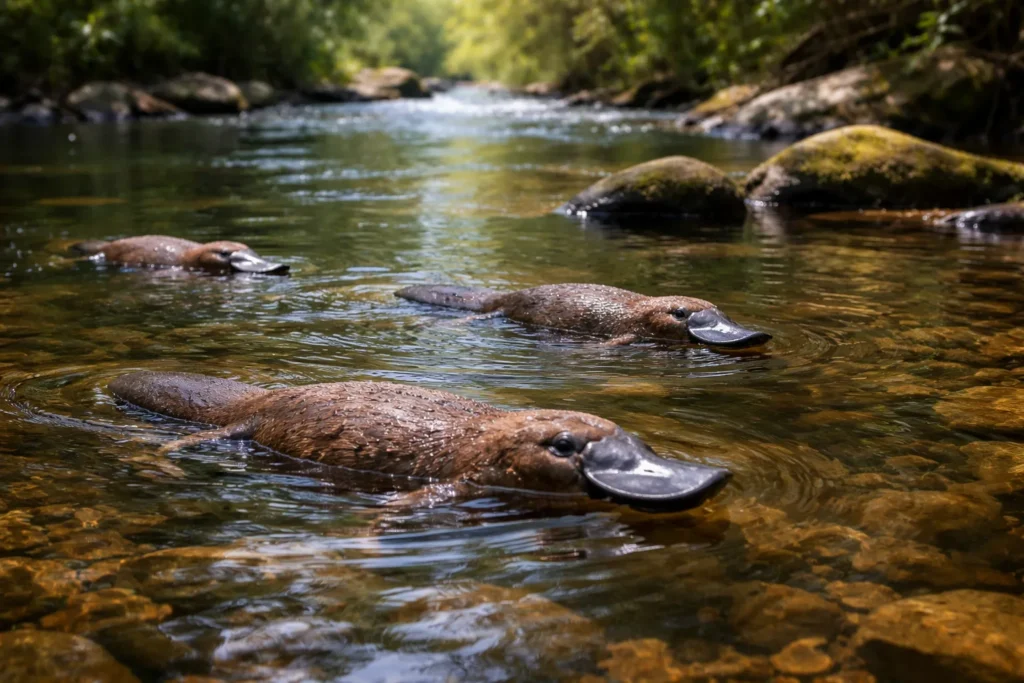
Is It Dangerous to Touch a Platypus?
Yes — and not just because of the venom. Platypuses are fast and strong in water. Grab one and it will thrash immediately — the hind legs kick instinctively, and that’s when envenomation happens. It’s not a decision the animal makes; it’s a pure reflex.
There’s also a bacterial risk most people don’t consider. Wild platypuses carry microorganisms their handlers’ immune systems have never encountered. Even a scratch without full envenomation can lead to a serious infection. These animals spend their lives in river sediment and mud — their microbial load is significant.
And touching one is illegal in Australia without a permit, full stop. If you find an injured platypus, call WIRES (Wildlife Information, Rescue and Education Service) at 1300 094 737. Leave it to people with the training, equipment, and thick gloves.
Can Platypuses Be Friendly?
“Friendly” gets complicated with wild animals, and with platypuses it gets complicated fast. They’re solitary — no social bonds outside of brief mating encounters, no play, no grooming, no group living. Warmth toward humans simply isn’t in their behavioural toolkit.
That said, wild platypuses in areas with regular human activity can become habituated — meaning they’ve learned humans aren’t a direct threat. They’ll sometimes keep foraging in shallow water while people watch from the bank nearby. That’s about as close to friendly as it gets.
In professional captive settings, careful long-term conditioning can produce something like tolerance — approaching a keeper for food, allowing brief handling without obvious stress. But even the keepers at Healesville Sanctuary are explicit: it’s learned tolerance, not affection. Non-threatening and occasionally tolerant? Yes. Friendly in the way most people mean it? Not really. As the threat of Platypuses Extinct looms larger each decade, even this fragile captive tolerance represents one of the last windows humans may have into the behavior of this remarkable species.

Can You Hug a Platypus?
No! and you really shouldn’t try. Beyond the legal issues, the physical reality makes it a bad idea. Platypuses weigh around 1–2.4 kg and are built almost entirely for aquatic movement, streamlined, slippery, with limbs that splay at awkward angles. Holding one without causing distress requires specific training and proper technique.
More to the point, hugging one puts your arms and torso within easy range of those hind legs. Even a calm platypus can be pushed into a defensive kick by the stress of being held by an unfamiliar human. Platypus venom on your forearm is not something people who’ve experienced it recommend.
They’re undeniably adorable — but they’re wild animals with serious defensive hardware, not stuffed toys. The most respectful thing you can do is admire them from a safe distance.
Are Platypuses Intelligent?
More than most people assume. Platypuses are monotremes — the oldest lineage of living mammals, branching off roughly 166 million years ago. For a long time, “ancient” was treated as synonymous with “primitive.” That thinking is being revised.
Their standout cognitive feature is electroreception. The bill contains around 40,000 electroreceptors and 60,000 mechanoreceptors, detecting the tiny electrical fields produced by prey muscle contractions underwater. They hunt with eyes, ears, and nostrils completely closed — finding food through pure electrical sensing. That requires serious neural processing.
They also show real spatial memory, returning reliably to productive foraging spots, and have been observed solving simple problems in captivity and distinguishing familiar from unfamiliar objects.
Do Platypuses Dream?
Here’s one that tends to surprise people: platypuses display more REM sleep than almost any other studied animal. REM is the stage associated with dreaming in humans. What a platypus actually dreams about is anyone’s guess — but the fact that their brains run that kind of complex activity during sleep points to a richer cognitive life than their reputation suggests. They’re not puzzle-solvers in the way crows or great apes are, but calling them unintelligent misses the point. They’re intelligent in ways that evolved over millions of years, and those ways just look very different from ours.
The Bottom Line
Platypuses are dangerous in the same way that a lot of Australian wildlife is dangerous: not because they’re out to get you, but because they’re wild animals with effective defences and they will use those defences if pushed. The venom is real, the pain is severe, and the lack of an effective antivenom makes it a medical situation you genuinely don’t want to find yourself in.
But they’re also extraordinary. An egg-laying, venomous, electroreception-using, biofluorescent mammal that glows blue-green under UV light and holds potential cures for diabetes in its venom, it reads like something a first-year biology student invented to win a bet. And yet here we are.
Respect them from a distance. Don’t try to keep one. And if you ever get the chance to see one in the wild in eastern Australia, consider yourself incredibly lucky — populations have dropped significantly, and encounters are rarer than they used to be.
From a safe distance, there’s nothing quite like them on Earth.




Pingback: Is it Legal to Own a Platypus? - Animal Sound
Pingback: Can Platypus live in Captivity? - Animal Sound
Pingback: How Do Platypuses Live? - Animal Sound
Pingback: Can You Own a Pet Platypus? - Animal Sound
Pingback: Are Platypuses Extinct? Here's What's Actually Going On - Animal Sound
Pingback: Platypus Venom: What It Does, How Dangerous It Is! - Animal Sound
Pingback: Platypus Care and Price Tags - Animal Sound