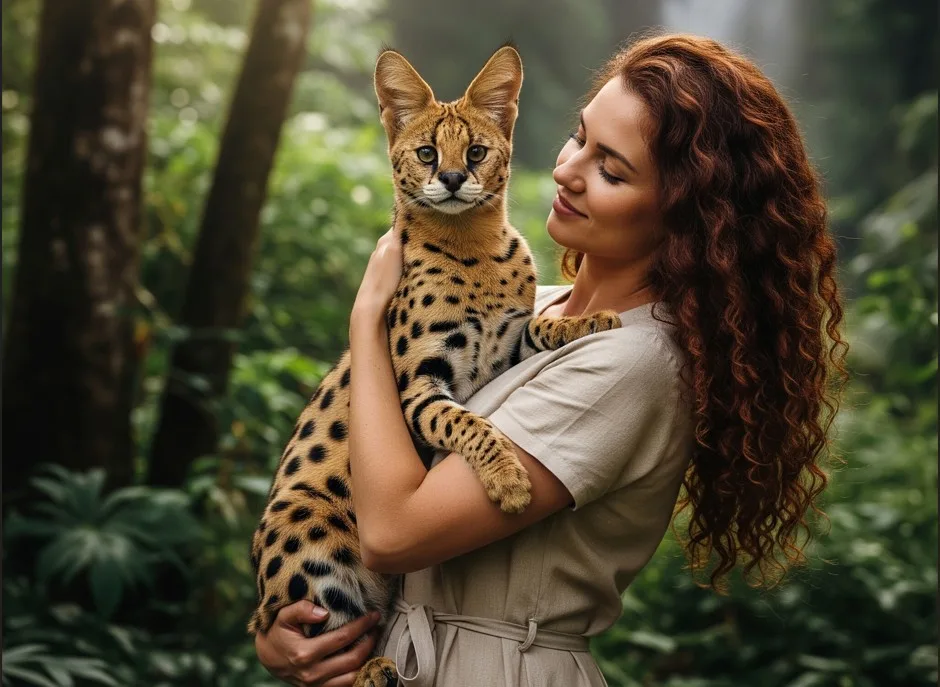
Finding a serval cat for sale requires careful consideration and thorough research due to the legal, ethical, and financial complexities of ownership.
The primary way to acquire a serval kittens for sale is through a reputable, specialised breeder. Reputable breeders often require buyers to live in a state where serval ownership is legal and may offer consultations to help you determine if a serval is the right pet for you
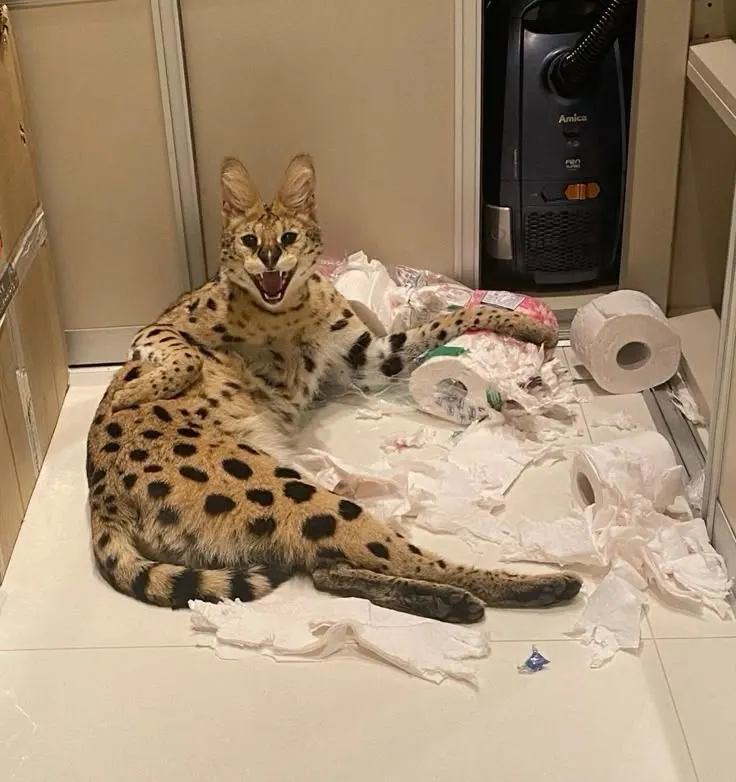
Where to Find Serval Cats for Sale
If you’ve been searching for a serval cat for sale, you’ll quickly discover they aren’t available in regular pet shops. Because servals are exotic wild cats, you can only buy them from licensed and reputable sources. Here are the main options:
1. Licensed Exotic Cat Breeders
Most people who buy a serval kitten go through USDA-licensed breeders (in the USA) or government-approved breeders (UK & Canada). These breeders bottle-raise the kittens so they’re socialized from birth. Always check:
- USDA license (in the USA) or DWA licence (in the UK).
- Health certificates and vaccination records.
- Proof of legal ownership and (if needed) CITES paperwork.
Reputable breeders sometimes advertise serval kittens for sale on their own websites or through exotic cat associations.
2. Exotic Animal Classifieds
Specialized pet marketplaces often list serval for sale ads. For example, U.S. exotic animal classified websites regularly feature kittens, with prices ranging from $4,000–$8,000+ depending on age, sex, and breeder reputation. Always research the seller carefully—scams are common.
3. Savannah Cat Breeders (Hybrid Option)
If a full serval is too difficult to find or own legally in your area, many breeders instead offer savannah kittens for sale. Savannahs are serval × domestic hybrids and much easier to own in the USA, UK, and Canada (especially F4+ generations). Searching for savannah cat sale will bring up dozens of TICA-registered catteries with available kittens.
4. Exotic Animal Rescues and Rehoming
Rarely, a serval may be surrendered by its previous owner. Some exotic pet rescues or sanctuaries in North America list adult serval cats for adoption. Adoption fees are usually far lower than the average serval cat price, but availability is limited.
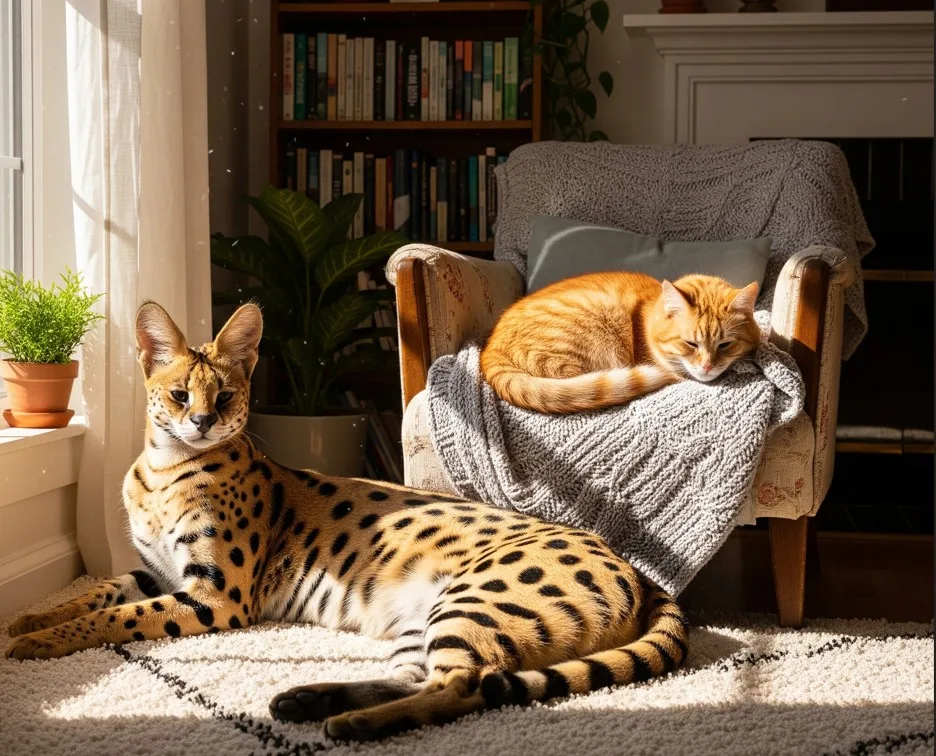
Serval Breeders & Adoption Resources
If you’re set on an exotic feline friend, connect with reputable breeders and rescue groups. Savannah breeders: Look for TICA-registered catteries or approved breed clubs (many have “Savannahs for sale” pages). Attend cat shows where Savannahs are exhibited. In the UK and Europe, check clubs like The International Cat Association (TICA) Savannah Breed Section for breeder listings. In the USA and Canada, many breeders advertise on cat forums or sites like TheCatSite and breeder directories. Always verify that the kittens are healthy and up-to-date on vaccines.
Serval breeders: These are rare; most are large private breeders or sanctuaries with breeding permits. In the U.S., USDA-licensed private breeders sometimes appear in exotic animal classifieds (one Florida breeder advertises “USDA permitted, bottle-fed serval kittens”). Outside the U.S., be extremely cautious—sales may be illegal. Never buy a serval from an unknown source or the pet trade black market.
Rescues and sanctuaries: Pure servals and early-generation Savannahs can be surrendered or seized, but few municipal shelters accept them. In North America, specialized rescues like the Wildheart Trust (UK) or Florida Wildlife Care (US) occasionally take in needy Savannahs/servals, but they rarely re-home them. Check local exotic animal rescues – adoption is sometimes possible if the cat is already in a private home that needs rehoming. We also recommend our exotic pet adoption guide (internal link) for tips on finding reputable rescues and planning.
Where to Find a Serval Cat or Savannah Kitten
If owning a serval or Savannah as a pet is legal in your area, the next step is finding a reputable source. So how to find a Savannah kittens for sale: Most Savannahs come from private breeders registered with TICA (The International Cat Association) or national cat clubs. Reputable breeders list litters on their websites or exotic cat classified sites. For example, UK sites like Pets4Homes often show dozens of “Savannah kittens for sale”, and there are dedicated TICA-registered catteries worldwide.
Expect to fill out questionnaires and provide references, as good breeders screen buyers carefully. Savannah kitten price varies widely: per one breeder, Savannahs “can be as little as $500 to up into the $20,000-plus range”, with the highest prices for F1/F2 kittens and rare coat colors.
Buy a Serval Cat: Pure servals are much rarer in the pet trade. In the USA, most servals for sale come from USDA-licensed exotic cat breeders. They are sometimes listed on exotic animal classified ads. For example, one 2025 ad advertised 1-month-old serval kittens at $4,500. Adult servals (pet or breeder quality) commonly run $5,000–$7,000, as shown in listings. Outside the U.S., servals are very hard to find legally; the UK requires a license so only a few licensed individuals keep them.
Anyone searching for “serval kitten for sale” should be extremely cautious: ensure the seller has proper permits and health records. Rescue organisations for big cats rarely rehome servals to the public (they are extremely challenging to care for), so most servals in homes come directly from breeders.
When buying any exotic cat, always verify credentials. A Serval seller should have documentation (e.g. CITES paperwork if imported) and USDA permits (in the U.S.). For Savannahs, require TICA registration papers proving the generation and lineage (to ensure F4+ if that’s a legal requirement). Never buy a Serval kitten or
an exotic cat without seeing its veterinary health certificate and confirming it is legally obtained. Remember the wise advice: “research and consult with local authorities to ensure compliance” before any purchase.
Legal Requirements by Region
Before looking for Serval cat for sale or any purchase, check the law. Exotic pet regulations vary widely. As WorldPopulationReview advises, “it is crucial…to thoroughly research and consult with local authorities” on Serval ownership. Below is a quick overview for the USA, UK, and Canada:
Serval Cat Legality in the United States
U.S. laws differ by state. According to a 2024 survey, a handful of states allow private servals at all (often without permit), a larger group allow them with permits, and many ban them outright. For example, Illinois, Michigan, Montana, North Carolina, South Carolina, Tennessee, and West Virginia allow serval ownership without a state permit. States like Alabama, Louisiana and Texas don’t require a state permit (though local county rules may apply). Many other states (Arkansas, Florida, Idaho, etc.) allow servals only with a license and/or inspection. In contrast, the “remaining” states (including Arizona, California, Colorado, Connecticut, Georgia, etc.) explicitly ban private servals and even to . Notably, Arizona law (and similarly Idaho’s) classify servals as dangerous exotics needing a permit.
Savannah cats are mostly treated as domestic in U.S. law, but early generations can be regulated. California, for instance, bans F1 Savannahs: its law explicitly allows “Savannah cats that are not first generation”. Other states with strict exotic laws may limit F1–F3 hybrids. By contrast, Illinois law plainly states “It is legal to own a Savannah cat”. In practice, buyers of Savannah kittens should still check their state/county regulations, especially for F1/F2 cats, to ensure compliance.
Serval Cat legality in United Kingdom
UK law is stringent for exotic cats. Servals are classed as “Dangerous Wild Animals” – you must obtain a DWA license from your local council to keep one. Savannah cats are treated more like domestic pets once they are several generations removed. An F1 Savannah (50% serval) requires a license, but “from F2 onwards no such restrictions exist”. Zooplus Magazine confirms that by roughly the 4th or 5th generation, Savannahs are considered purely domestic with “no restrictions whatsoever”. In short, in the UK you can buy Savannah kittens for sale freely once they are high-generation (F4+), but a pure serval or a first-generation Savannah needs licensing.
Serval cat legality in Canada
Canadian regulations vary by province and are evolving. Alberta, for example, restricts hybrid cats: F1–F3 Savannahs are banned, and only F4 or later generations may be privately owned without a permit. According to a Savannah breeder’s site, Alberta “is not permitted to own a serval cat”. By contrast, British Columbia currently has no specific ban on servals – servals are not on BC’s “Controlled Alien Species” list, meaning they aren’t legally prohibited. (Note that BC advocacy groups are pushing for a ban due to welfare concerns, but as of 2024 Servals remain legal there.) Quebec and Ontario have had various exotic pet bills and may require permits or impose bans, so check provincial wildlife laws before buying.
Key takeaway: always confirm province and municipal laws. For instance, Alberta explicitly requires Savannahs to be 4th-generation or beyond, and even suggests a “pet passport” (CITES permit) for import.
Serval Cat Price
The serval cat price is a significant initial investment, ranging from $5,000 to $20,000 or more for a serval kitten. The price can fluctuate based on factors like the breeder, the animal’s genetics, age, gender, and location.
For those considering a Savannah cat as an alternative, the price is determined by its filial (F) generation, which indicates how many generations it is removed from its serval ancestor. The closer the generation is to the serval, the higher the price, primarily due to the difficulty of breeding early generations, as well as their rarity, larger size, and more exotic appearance.
- f1 savannah cat for sale : The most expensive, with prices typically ranging from $12,000 to $25,000 or even more. In some cases, female F1s can cost up to $35,000.
- F2 Savannahs: Prices for these kittens are generally between $4,000 and $12,000.
- F3 Savannahs: The cost decreases to a range of $1,000 to $4,000.
- Later Generations: F4 and F5 Savannahs are the most affordable, with prices typically between $1,000 and $2,500.
It is important to note that the Serval cat price is only the beginning of the financial commitment. Owning a serval or a Savannah cat comes with significant ongoing costs for specialized food, veterinary care, and housing
Cost of a Serval cat
Owning an exotic cat is expensive. Serval cat price: As noted, serval kittens often cost several thousand dollars. Adult servals (already weaned, even not fully socialized) may still be ~$3,000–$5,000. Breeding pairs go for more (e.g. listings show two adults for $7,000 total). Beyond purchase price, budget for an enclosure (often custom-built), veterinary care, and specialized diet.
Savannah cat price: Savannah pricing depends on generation and gender. Female F1 kittens might run $15,000–$20,000, while F1 males are slightly less ($12,000–$16,000). By F2/F3, prices drop (often $2,000–$8,000). Later-generation Savannahs (F4+) are much cheaper – often under $2,500 even for show-quality. As Belle Hollow Farms explains, costs “go down” with each generation from Serval. In summary, factor in pet deposits, spay/neuter fees (often required by breeders), and veterinary exams.
Caring for Your Serval or Savannah Cat
Both Servals and Savannahs need special care.
Servals and Savannahs’ Diet:
In the wild Servals eat rodents, birds and fish. In captivity, they thrive on a high-protein raw diet. Zooplus Magazine notes captive servals should be fed fresh meat with vitamin/mineral supplements. In practice, owners feed raw game meat, poultry, or specialized feline raw diets. Savannahs also do well on high-meat diets. Important: work with a vet experienced in exotic cats; servals especially need regular check-ups and their own set of vaccinations.
Enclosure and environment for Servals and Savannahs:
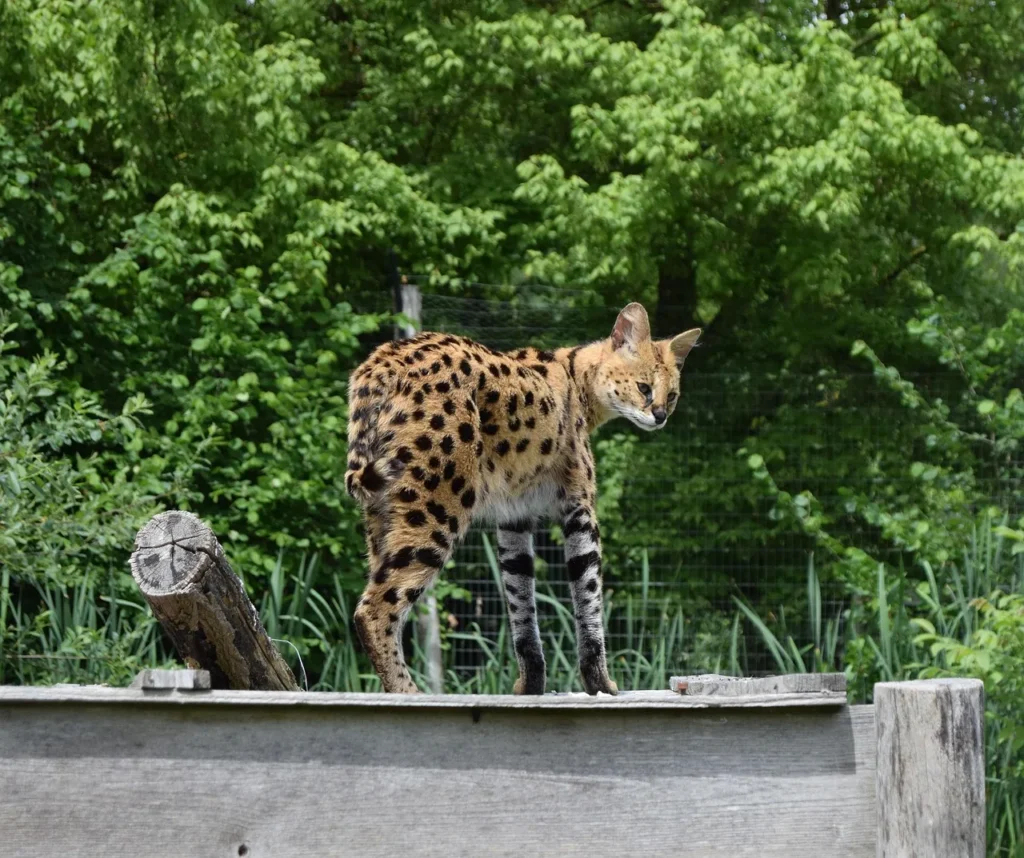
Servals are agile jumpers (up to 11 feet high!) and need a secure, tall enclosure. Ideally provide a walk-in enclosure with climbing structures, deep substrate for digging, and even a pool (servals enjoy water). Never let a serval roam unsupervised; they tend to wander far if given a chance. Savannah cats, while more domestic, also love high perches and hunting games. Both require ample space – a spare room or large yard (fenced) is ideal. Enrichment is crucial: toys, puzzle feeders, and play sessions help meet their high energy.
Servals and Savannahs Behaviour and training:
After you buy a serval kitten you should know Servals are not easily litter-trained and often mark territory. Even a well-socialized serval “may not want to be pet or cuddled”. Savannahs are more trainable; many owners teach them to use a litter box and walk on a harness. Both appreciate early socialization with people. Note from Discover Wildlife: these hybrids “need a lot more stimulation, enrichment and attention than the average cat”. The RSPCA warns it can be “extremely difficult” to meet a Savannah cat’s needs in a normal home. In short, expect to spend several hours a day interacting and providing enrichment.
Health and vet care:
Find a veterinarian with exotic or wildlife experience. Both servals and Savannahs may need annual parasite prevention and parasite checks every 3 months (like a ferret or exotic pet). Recall: declawing servals is illegal in places like BC; give them scratching posts to protect their claws. Always microchip and insure (exotic pet insurance is available) in case of escape – servals in particular can disappear quickly, so before thinking to buy a Serval kitten or Savannah kittens, make sure u already know a veterinarian with exotic or wildlife experience.
Care Tips Checklist
Before you take home an exotic kitten or cat, make sure you can meet its needs. Here’s a quick checklist:
- Legal home: Have you secured the proper permits or licenses? (Laws vary by state/province; see above.)
- Space: Is there a large, secure enclosure (outdoor run or roomy indoor space)? (Servals need tall, fenced areas – even extending underground – and Savannahs thrive on vertical space.)
- Social time: Are you home often? (These cats need constant interaction and play – not ideal if you travel or work long hours.)
- Veterinary care: Do you have access to an exotic-pet vet?
- Budget: Have you planned for initial costs and ongoing costs (food, vet, enclosure)? (See our pet cost planning guide.)
Meeting all these ensures you’re ready for the commitment.
Serval vs. Savannah – Key Differences
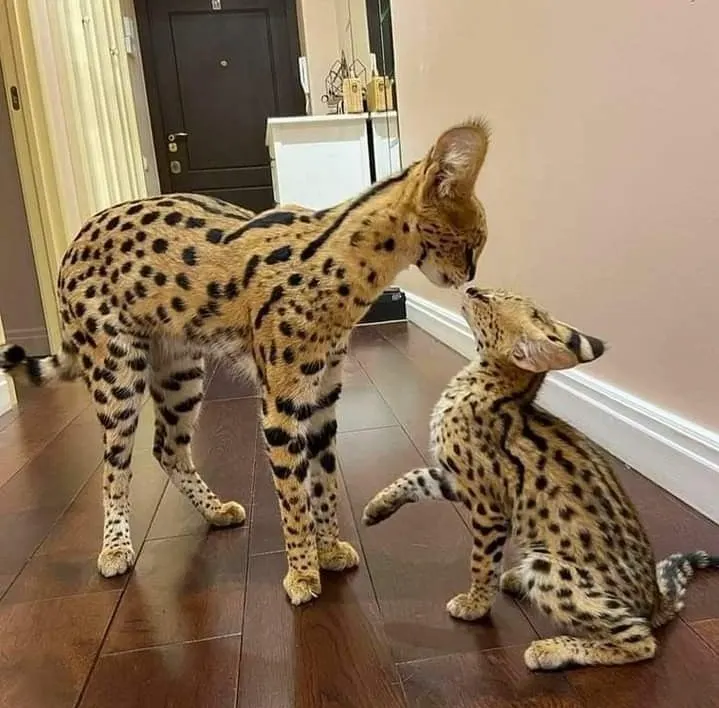
When people search for “serval ” or “savannah ”, they often confuse the two. Serval vs. Savannah – Key Differences: Servals are wild predators and are not a domestic breed. They are tall, have the longest legs of any cat (up to 18 kg), and their behavior remains largely wild. Savannah cats (the offspring of a serval and a house cat) are domestic cats that look exotic. For example, Savannahs are described as having “tall and sleek bodies, large ears, long legs and large paws”. Owners note Savannahs often show “loyalty and energy of new puppies” alongside cat-like independence. In general, servals (wild) and Savannahs (hybrid) differ in:
- Size and appearance: Servals are much larger (up to 40 lbs) than most cats; Savannahs typically range 8–30 lbs depending on generation and sex. Both have spotted coats, but servals’ legs are proportionally longer, making them look more like miniature wild cats.
- Behavior and trainability: Servals retain wild instincts – they are not easily house-trained and tend to mark territory or roam if unconfined. Zooplus notes that even well-socialized servals “still appear much more wild and primal than a normal cat”. Savannahs, especially later generations (F2+), are more sociable and trainable than servals, but still need more space and enrichment than average housecats.
- Breeding generation: A first-generation (F1) Savannah is half-serval and behaves most like a mini-serval; F2, F3, etc., have less wild blood. Generally, only F4+ Savannahs (4 generations removed) are treated purely as domestic pets in law.
These differences matter when considering care: servals require outdoor enclosures and a specialist diet, while many people seeking “savannah kittens for sale” want a more typical cat experience (though still very active).
Is a Serval Cat Right for You?
The journey from searching for a serval cat for sale to making a responsible decision is a long and complex one. This guide has detailed the immense financial commitment, the fragmented legal and ethical landscape, and the demanding reality of daily Serval care. A serval cat is not a domesticated animal. It is a wild creature with instincts that cannot be fully trained away.
If, after considering all the facts, buying a serval kitten does not seem right, a Savannah cat is a more manageable and safe alternative that retains the striking appearance of its wild ancestor, even though it’s hard to find a Savannah kittens for sale.
In fact, many people who initially bought a serval later realize they are too much to handle and end up with a Savannah instead. A more domestic alternative, such as a Bengal cat, is another option for those who are interested in a pet with an exotic appearance. The ultimate goal of this guide is not to encourage you to buy a serval cat but to provide the information necessary to make a truly informed and responsible decision. The fascination with exotic animals should inspire a desire to protect them, not to possess them.
Conclusion
Owning a serval or Savannah cat can be rewarding, even trying to look for Serval Cat For Sale, but it is also a huge responsibility. They are not like kittens – they grow into powerful, energetic cats that require expert care, secure housing, and a big commitment of time and money. If, after researching, you decide this is right for you, proceed cautiously: use reputable breeders, ensure full legal compliance, and prepare your home thoroughly. And as always, consider that many exotics (including Savannahs) can be adopted from rescues — check our article on exotic pet adoption for alternatives to buying.
Whether you’re searching for “serval cat for sale” or “savannah cat sale”, remember to prioritize the cat’s welfare. Refer to our other guides on exotic pet care, adoption, and pet expense planning for more on giving your new exotic feline the best possible home.


Pingback: Fennec Fox for Sale Near You – USDA-Licensed Breeder - Animal Sound